
 Mar, 7 2026
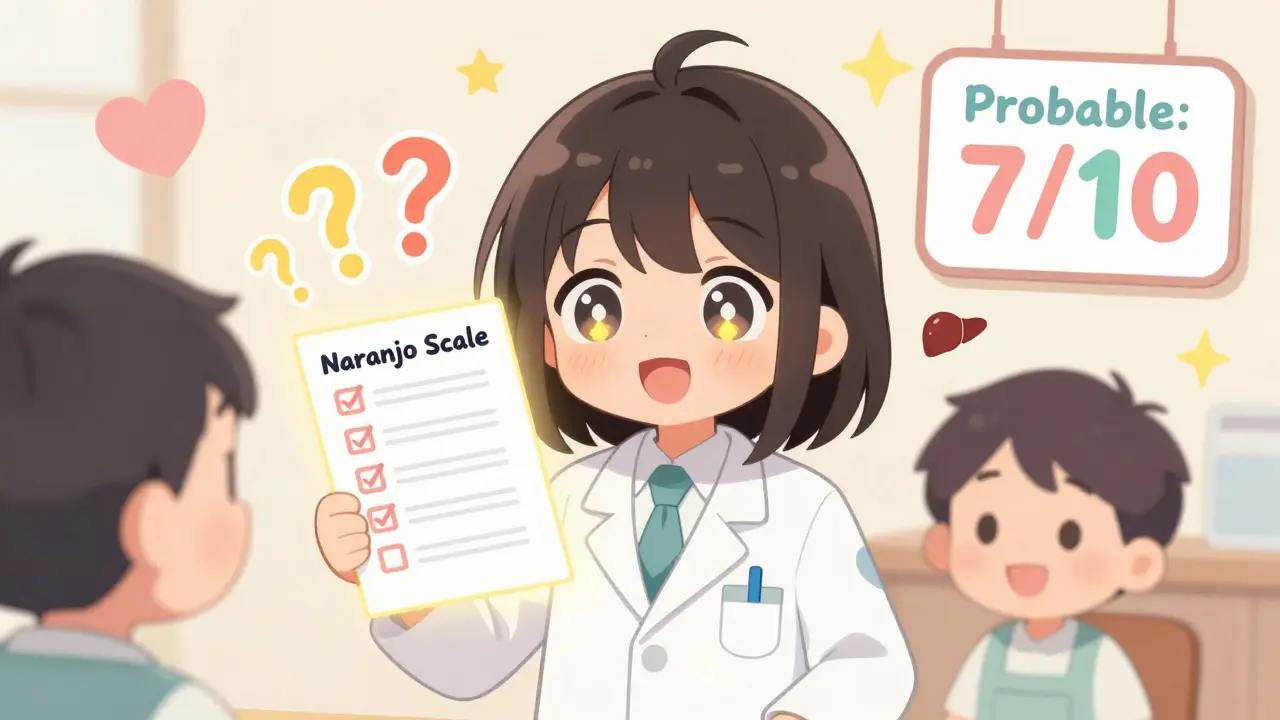
When a patient develops a rash, dizziness, or liver damage after starting a new medication, how do you know if the drug actually caused it? It’s not always obvious. Maybe it was the new food they ate. Or a virus they caught. Or an interaction with another drug. This is where the Naranjo Scale comes in. It’s not a lab test. It’s not a machine. It’s a simple, 10-question checklist that helps doctors, pharmacists, and nurses figure out if a bad reaction was really caused by a drug - or if something else is to blame.
How the Naranjo Scale Works
The Naranjo Scale was created in 1981 by a team of researchers led by Dr. Carlos Naranjo. It was developed because, after the thalidomide disaster in the 1960s, the medical world realized it needed a better way to link drugs to side effects. Before this, reports were mostly guesswork. Now, every time a patient has a strange reaction, clinicians can use this tool to make a more informed call.
The scale has 10 yes-or-no questions. Each answer gets a score: +2, +1, 0, or even -1. You add up the points, and the total tells you how likely the drug caused the reaction. There are four possible outcomes:
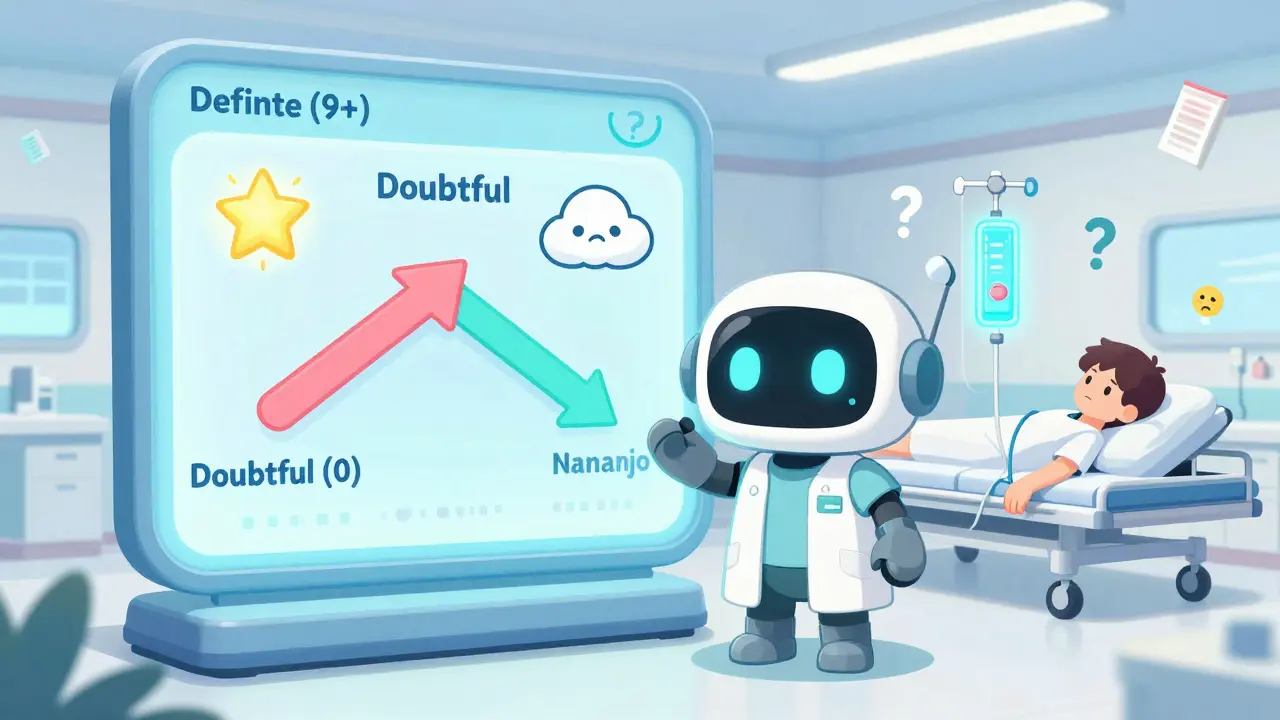
- Definite (9 or higher): The drug almost certainly caused the reaction. The timing matches, symptoms improved after stopping the drug, and there’s no better explanation.
- Probable (5 to 8): Very likely the drug caused it. The evidence is strong, but maybe re-exposure wasn’t possible, or there’s a small chance of another cause.
- Possible (1 to 4): Maybe the drug did it. The timing fits, but other factors - like an infection or another medication - could explain it.
- Doubtful (0 or lower): Unlikely to be the drug. Something else is probably responsible.
Here’s what the 10 questions actually ask:
- Have there been previous reports linking this drug to this reaction?
- Did the reaction happen after the drug was started? (Timing matters - it should be within a known window.)
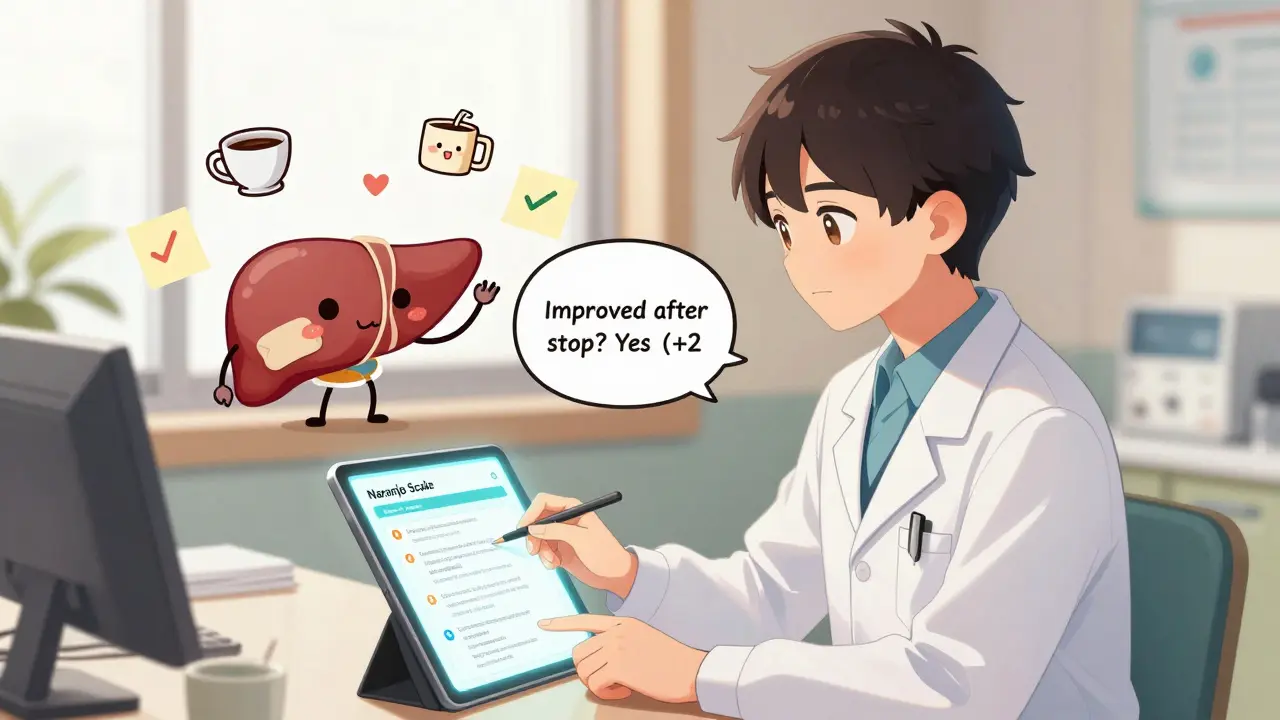
- Did symptoms improve when the drug was stopped?
- Did symptoms return when the drug was given again? (Rechallenge - this one’s tricky and often skipped.)
- Are there other possible causes for the reaction? (This is where clinical judgment kicks in.)
- Was a placebo given to see if the reaction happened without the drug? (Ethically controversial today.)
- Was the drug at toxic levels in the blood?
- Did increasing the dose make the reaction worse?
- Has the patient had this same reaction to this drug before?
- Is there objective evidence - like a lab test or biopsy - confirming the reaction?
It sounds simple, but answering these questions accurately takes experience. You need to know how long it takes for a drug to cause liver damage. Or how long it takes for a rash to clear after stopping a medication. You need to know what other conditions can mimic a drug reaction.
Why It Still Matters Today
Even in 2026, with AI and fancy databases, the Naranjo Scale is still used in 78% of published drug safety studies. Why? Because it’s transparent. You can see every step. You don’t need special software. Any hospital, clinic, or pharmacy can use it.
Regulators like the FDA and the European Medicines Agency still recommend it. When a patient reports a serious side effect to the FDA’s FAERS system, the Naranjo Scale is often the first tool used to decide if the report is credible enough to trigger further investigation.
Pharmacovigilance teams in hospitals use it daily. One pharmacist from Massachusetts General Hospital told a Reddit thread: “We use it every day. It forces us to look at all the evidence - not just our gut feeling.”
It’s also built into electronic health record systems. Epic’s safety module, for example, automatically fills in four of the 10 questions based on when the drug was prescribed, when symptoms started, and whether the drug was stopped. That saves time and reduces human error.
Where It Falls Short
But the Naranjo Scale wasn’t designed for today’s medicine. It was made for aspirin, antibiotics, and blood pressure pills. It struggles with modern drugs.
Take immunotherapy. A patient gets a cancer drug that triggers an autoimmune reaction. The reaction doesn’t show up for weeks. It might not go away even after stopping the drug. The Naranjo Scale asks if symptoms improved after stopping - but what if they didn’t? That’s a 0. That could push a definite reaction into “possible.” That’s wrong.
Or consider gene therapy. One dose lasts a lifetime. You can’t stop it. You can’t rechallenge. The scale’s questions about stopping and restarting the drug are useless here.
Another big problem: Question 6 - the placebo challenge. In 1981, giving a patient a sugar pill to see if the reaction returned was considered acceptable. Today? It’s unethical. No doctor would risk making a patient sick again just to prove a point. So most people answer “don’t know,” which lowers the score. That’s not fair. The patient might have had a definite reaction - but the scale doesn’t reflect that.
And then there’s polypharmacy. Elderly patients often take 8-10 medications. The Naranjo Scale only looks at one drug at a time. If a patient is on five drugs and develops kidney damage, which one caused it? The scale can’t tell. That’s why newer tools like the Liverpool ADR Probability Scale were created - they can weigh multiple drugs.
How People Use It Today
Most users don’t fill out the paper form anymore. Digital tools are taking over.
A 2023 study in Cureus tested a Python-based calculator. It cut assessment time from 11 minutes to 4.2 minutes. Error rates dropped from 28% to 9%. That’s huge. The tool even blocks illogical answers - like saying a reaction happened before the drug was given.
On GitHub, there’s an open-source Naranjo calculator with over 2,000 stars. Hospitals are integrating it into their reporting systems. Medical schools are teaching it. The Fiveable platform has 12 interactive case studies used by over 15,000 nursing and pharmacy students.
But even with digital help, human judgment is still essential. One clinical pharmacist from Johns Hopkins said: “Rechallenge is impossible in 90% of cases. We default to ‘don’t know.’ That skews results. We’re forced to call things ‘probable’ when they might be ‘definite.’”
What’s Next for the Naranjo Scale?
The scale isn’t going away. But it’s evolving.
In June 2024, the International Council for Harmonisation proposed replacing Question 6 with a new one: “Is there evidence from therapeutic drug monitoring that supports the reaction?” That’s smarter. It uses blood levels instead of risky placebo tests.
Some experts are blending the Naranjo Scale with other tools. The ALDEN algorithm, for example, adds drug-specific risk factors - like whether a drug is known to cause liver injury in older adults. It’s not a replacement. It’s a supplement.
AI systems like the FDA’s Sentinel Initiative are now using machine learning to predict drug reactions. But even those systems often start with the Naranjo Scale as a baseline. It’s the common language.
So what’s the future? The Naranjo Scale won’t be replaced. It’ll be upgraded. Digital tools will handle the math. Clinicians will focus on the hard parts - interpreting ambiguous symptoms, weighing competing causes, and knowing when to trust the score and when to ignore it.
Final Thoughts
The Naranjo Scale isn’t perfect. It’s old. It’s rigid. It doesn’t handle modern drugs well. But it’s the best thing we’ve got for a quick, objective, and standardized way to ask: “Was this drug the problem?”
It turns guesswork into evidence. It forces us to slow down and look at the facts. And in a world where drug reactions cause over 200,000 hospitalizations a year in the U.S. alone, that’s not just helpful - it’s lifesaving.
If you’re a clinician, learn it. If you’re a student, practice it. If you’re a patient, understand that when your doctor says, “This reaction is probable,” they didn’t just make that call. They used a tool built on decades of science - and it still works.
Tom Sanders
March 8, 2026 AT 14:38Jazminn Jones
March 9, 2026 AT 22:41Stephen Rudd
March 11, 2026 AT 03:25Erica Santos
March 11, 2026 AT 10:51George Vou
March 12, 2026 AT 12:55Scott Easterling
March 14, 2026 AT 04:56Mantooth Lehto
March 15, 2026 AT 19:05Melba Miller
March 16, 2026 AT 17:26Katy Shamitz
March 16, 2026 AT 22:44Nicholas Gama
March 18, 2026 AT 06:53Mary Beth Brook
March 19, 2026 AT 12:32Neeti Rustagi
March 19, 2026 AT 19:17Dan Mayer
March 20, 2026 AT 00:30Janelle Pearl
March 21, 2026 AT 23:14Ray Foret Jr.
March 22, 2026 AT 14:13