
 Dec, 8 2025
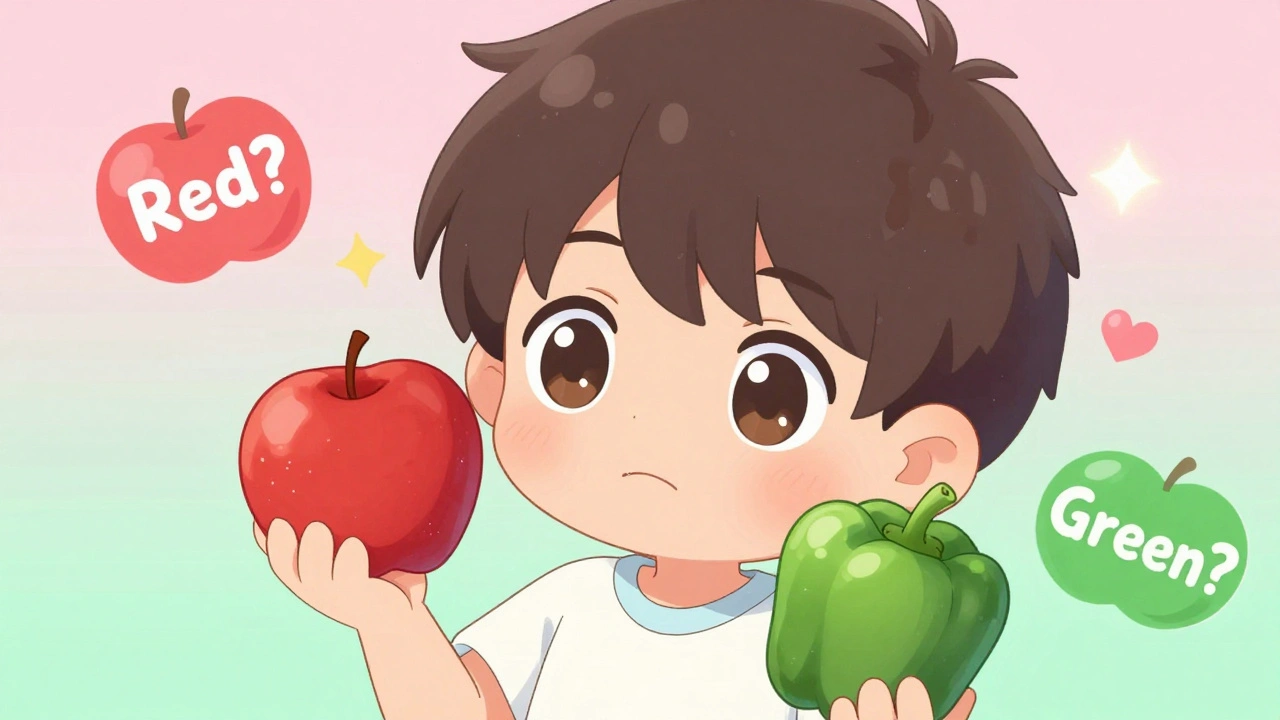
Most people think color blindness means seeing the world in black and white. That’s not true. The most common form-red-green color blindness-isn’t blindness at all. It’s a mismatch in how your eyes process certain colors. If you’re one of the 8% of men or 0.5% of women affected, you don’t see fewer colors. You just struggle to tell reds, greens, browns, and oranges apart. And it’s not something you develop later in life. You’re born with it. Because it’s built into your genes.
How Your Eyes See Color
Your retina has three types of cone cells, each sensitive to a different part of the light spectrum: short (blue), medium (green), and long (red). These cones work together to create the full range of colors you see. Red-green color blindness happens when the green or red cones don’t function properly. The problem isn’t with your eyesight sharpness-it’s with the pigments inside those cones. These pigments are made by proteins called opsins, coded by specific genes. When those genes are faulty, the pigments don’t absorb light the way they should. That’s when red looks too dark, green looks muddy, or you can’t tell the difference between a red apple and a green pepper.
The X Chromosome Connection
The genes for red and green cone pigments sit on the X chromosome. That’s the key to why this condition hits men far more often than women. Men have one X and one Y chromosome. If the X they inherit from their mom has a mutated color vision gene, they’ll have red-green color blindness. Women have two X chromosomes. They’d need both to carry the mutation to be affected. That’s rare. Statistically, if 8% of men have it, only about 0.5% of women do. That’s because even if one X has the mutation, the other one often compensates. It’s not perfect-some women with one mutated gene still notice subtle differences-but full color deficiency is uncommon in them.
Types of Red-Green Color Blindness
There are four main types, each with a different genetic cause:
- Deuteranomaly (most common): Green cones don’t work right. About 5% of men have this. Colors look washed out, especially reds and greens. It’s mild, and many people don’t even know they have it until they take a test.
- Protanomaly: Red cones are faulty. Reds look darker, almost brownish. About 1% of men. Often confused with deuteranomaly, but the way reds appear is different.
- Deuteranopia: No functional green cones. You see the world in blues, yellows, and grays. Reds and greens blend into a muddy brown. Affects about 1% of men.
- Protanopia: No functional red cones. Same as deuteranopia, but reds look black or very dark. Also affects about 1% of men.
Deuteranomaly is by far the most common. It’s so mild that many people live their whole lives without realizing they’re different-until they’re asked to identify wires in an electrical panel or spot a ripe tomato in a salad.
Why the Genes Get Mixed Up
The red and green pigment genes sit next to each other on the X chromosome in a long chain. Normally, you have one red gene and one or more green genes. But during sperm production, these genes can accidentally swap pieces with each other. That’s called unequal crossover. Sometimes, the swap deletes the green gene entirely. Other times, it creates a hybrid gene that doesn’t work right. That’s why so many cases of deuteranomaly involve a mix of red and green gene parts. Researchers at University College London found that nearly half of men with deuteranomaly have these hybrid genes. It’s not a random mutation-it’s a structural flaw in how the genes are arranged.
How It’s Diagnosed
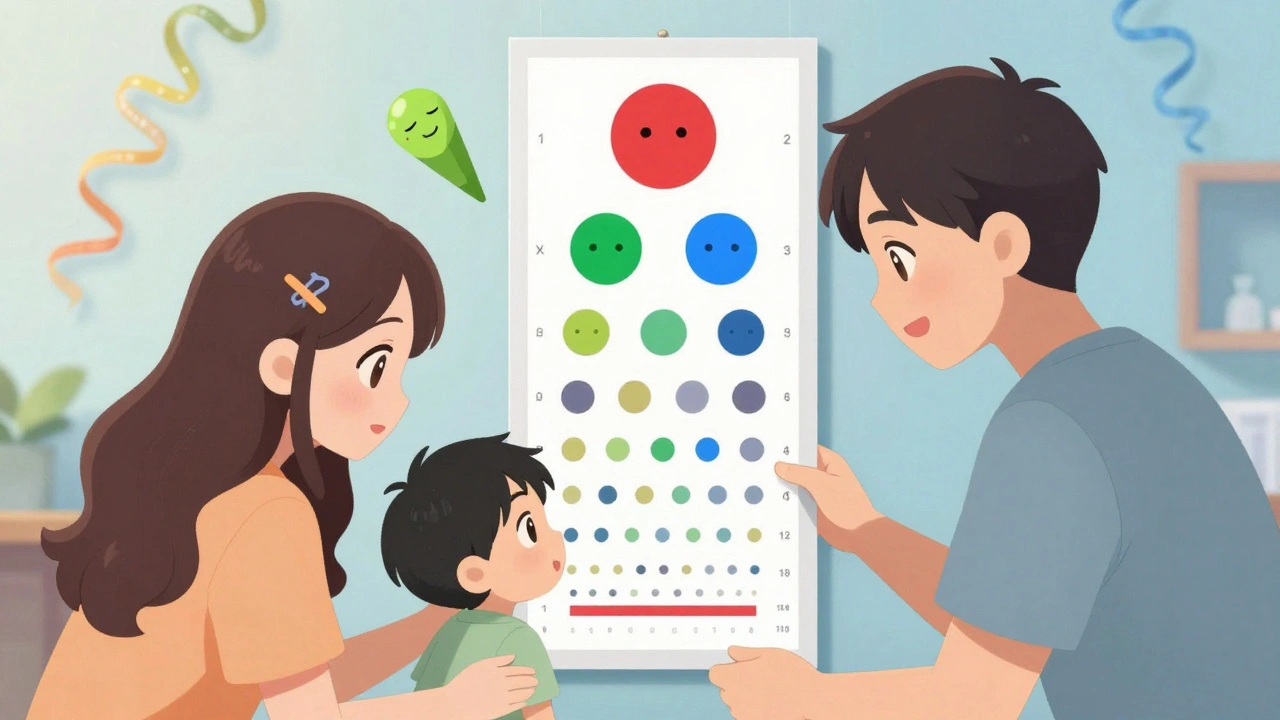
The most common test is the Ishihara test. It’s those plates with colored dots forming numbers. If you can’t see the number, you might have red-green color blindness. But it’s not perfect. Some people guess right by brightness, not color. That’s why eye doctors use more detailed tests now, like the Farnsworth-Munsell 100 Hue Test or the anomaloscope, which lets you match colors by adjusting brightness and hue. These are used in professions where color accuracy matters-pilots, electricians, graphic designers, and even some military roles.
Real-Life Challenges
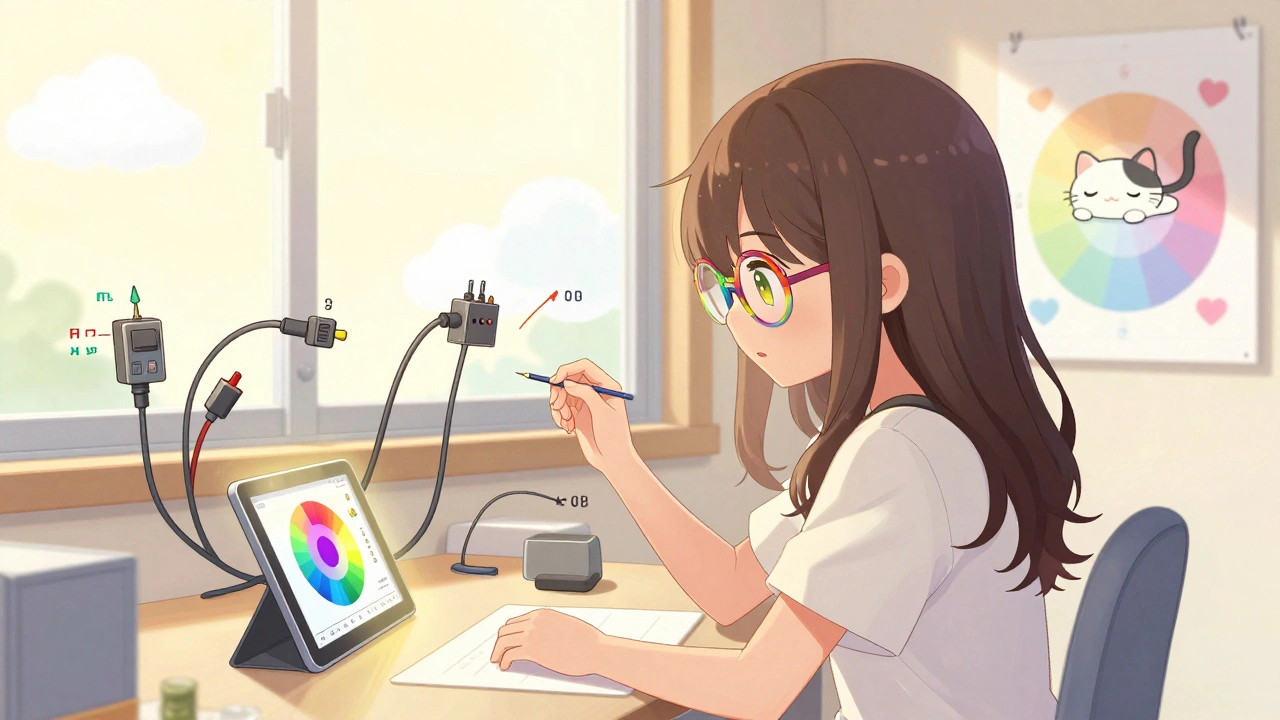
For most people, it’s a small annoyance. But in daily life, it adds up. A survey of over 1,200 people with red-green color blindness found that 78% had trouble with color-coded charts in school. 65% struggled with traffic lights, especially in fog or glare. 42% said apps and websites were hard to use because buttons or alerts relied only on color. One user, a commercial pilot applicant, was disqualified because he couldn’t pass the color test-even though his vision was 20/20. Another, an electrician, says he labels every wire with numbers because he can’t trust red vs. green.
But it’s not all hardship. Many people adapt brilliantly. A graphic designer on Reddit said learning to rely on contrast and shape made her designs clearer for everyone. She doesn’t see color the same way, but she’s become better at making visuals accessible. That’s the hidden upside: people with color blindness often notice patterns others miss.
Can It Be Fixed?
No cure exists. But tools help. EnChroma glasses cost between $329 and $499. They don’t restore normal color vision. They filter out overlapping wavelengths so red and green stand out more clearly. Studies show about 80% of users report better color discrimination, especially in natural light. But they don’t work for everyone-especially those with complete loss of cones (dichromats). They’re a filter, not a fix.
Digital tools are more accessible. Apple and Windows both have built-in color filters. The free Color Oracle simulator lets designers see how their websites look to someone with red-green blindness. The ColorADD system uses symbols inside colors-like a triangle for red, a circle for green-so you don’t need to see color to understand it. It’s used in public transit systems across 17 countries.
What About Gene Therapy?
Scientists have already restored color vision in monkeys. In a 2022 study, researchers used gene therapy to give adult squirrel monkeys a third type of cone pigment. Within weeks, they could distinguish red and green like normal primates-and kept that ability for over two years. It’s a huge breakthrough. The National Eye Institute is now funding research to see if the same approach could work in humans. But it’s still years away. Even if it works, it would only help people with certain types of gene mutations. It won’t fix everyone.
Why It Matters Beyond Vision
Color blindness isn’t just a medical curiosity. It’s a design problem. The European Union’s Accessibility Act requires public websites to avoid relying on color alone to convey information. The Web Content Accessibility Guidelines (WCAG) say you must use patterns, labels, or contrast-not just hue-to indicate errors, buttons, or status. Companies like Microsoft and Apple have made color filters standard because millions of users need them. And it’s not just about accessibility-it’s about inclusion. When you design for color blindness, you design better for everyone.
What You Can Do
If you think you might have red-green color blindness, get tested. It’s quick, non-invasive, and often free at eye clinics. If you’re diagnosed, don’t panic. Most people live full, normal lives. But learn to adapt:
- Use labels on wires, cables, or markers instead of colors.
- Turn on color filters on your phone or computer.
- Ask for color-blind-friendly materials at school or work.
- Use apps like Sim Daltonism to check how your photos look to others.
- If you’re a designer, always test your work with a color blindness simulator.
And if you’re a parent and your child struggles with color-based learning tools, talk to their teacher. Many schools now offer color-blind-friendly worksheets. It’s not a disability. It’s a difference. And with the right tools, it doesn’t hold anyone back.
Can color blindness get worse over time?
No. Red-green color blindness is congenital and doesn’t change with age. It’s present from birth and stays the same throughout life. Unlike conditions like macular degeneration, it doesn’t progress. What can change is how well you adapt to it. Many people develop better strategies over time, making it feel less noticeable.
Can women be color blind?
Yes, but it’s rare. Since the genes are on the X chromosome, women need two copies of the mutated gene-one from each parent-to be fully affected. That happens in about 0.5% of women. Some women with only one mutated gene may have mild symptoms, like difficulty distinguishing similar shades, but they rarely have full color deficiency.
Are color blind glasses worth it?
They can be, but not for everyone. EnChroma and similar glasses work best for people with deuteranomaly or protanomaly-those with partial cone function. They don’t help people who completely lack red or green cones (dichromats). About 80% of users report improved color contrast, especially outdoors. But they don’t restore normal color vision. They’re a tool, not a cure. Try them with a money-back guarantee before buying.
Can color blindness affect your career?
Yes, in some fields. Pilots, electricians, firefighters, and graphic designers often face restrictions. But many of these rules are outdated. In the U.S., the FAA allows some pilots with mild color vision deficiency to fly with special certification. The UK’s Equality Act 2010 requires employers to make reasonable accommodations. If you’re denied a job because of color blindness, you may have legal recourse. Always ask about alternatives-like using labels or tech aids-before accepting a denial.
Is color blindness genetic?
Yes. Red-green color blindness is inherited through the X chromosome. If your father has it, he can’t pass it to his sons (he gives them his Y chromosome), but he will pass it to all his daughters. If your mother carries the gene, each son has a 50% chance of having it, and each daughter has a 50% chance of being a carrier. Genetic testing can confirm the exact mutation, but it’s rarely needed unless you’re planning a family and want to understand risks.
Evelyn Pastrana
December 8, 2025 AT 20:06Nikhil Pattni
December 9, 2025 AT 21:24Arun Kumar Raut
December 11, 2025 AT 02:45precious amzy
December 12, 2025 AT 08:59Carina M
December 13, 2025 AT 23:43Richard Eite
December 15, 2025 AT 16:57Katherine Chan
December 16, 2025 AT 22:36Philippa Barraclough
December 18, 2025 AT 06:26Brianna Black
December 18, 2025 AT 13:33Shubham Mathur
December 19, 2025 AT 18:57Ronald Ezamaru
December 21, 2025 AT 06:41Lauren Dare
December 22, 2025 AT 17:04