
 Jan, 6 2026
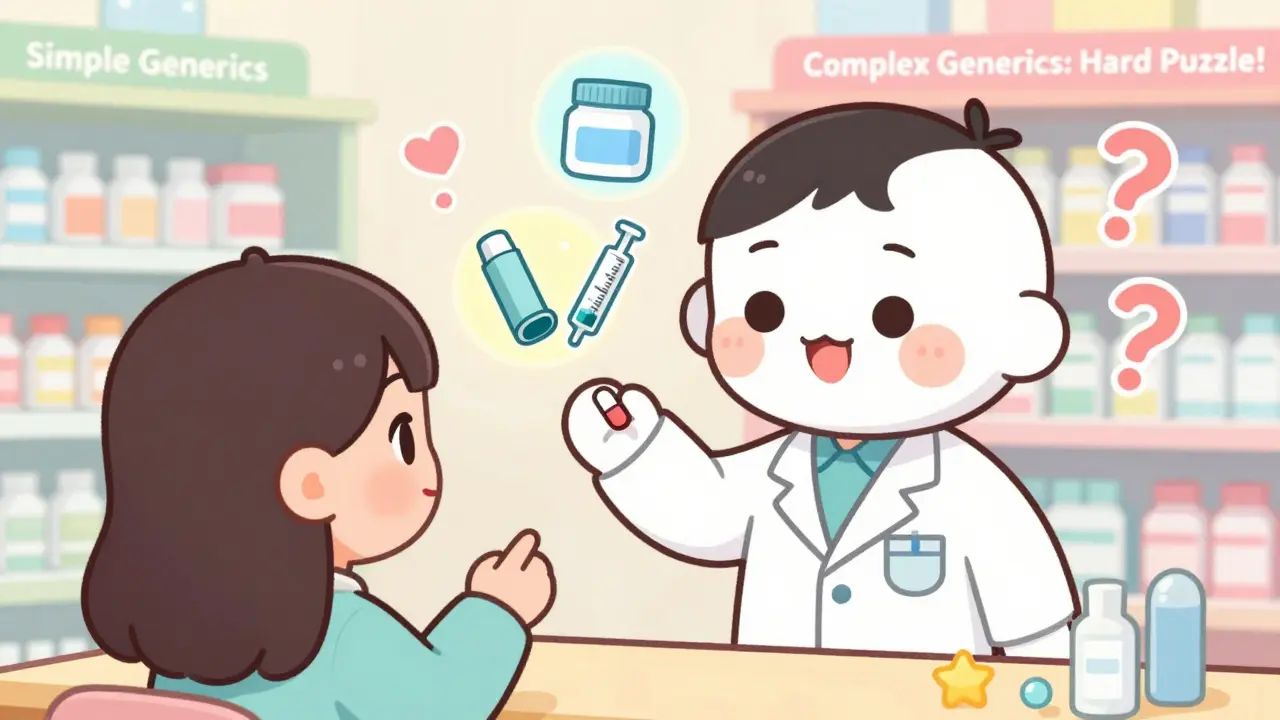
When you pick up a generic pill at the pharmacy, you expect it to work just like the brand-name version. That’s the promise. But for some drugs, especially the complex ones, proving they’re truly equivalent isn’t just difficult-it’s one of the biggest scientific challenges in modern medicine.
What Makes a Generic Drug "Complex"?
Not all generic drugs are created equal. Most are simple copies of small-molecule drugs like aspirin or metformin. These have clear chemical structures, dissolve predictably in the body, and can be tested using standard blood-level measurements. But complex generics? They’re different. These include things like inhaled asthma medications, topical creams for eczema, long-acting injectables, and drug-device combos like auto-injectors. They often contain ingredients that are hard to measure-like liposomes, nanoparticles, or polymers. Some are delivered directly to the skin, lungs, or eyes, where the drug is meant to act, not enter the bloodstream. The FDA calls these "products with complexity or uncertainty regarding the approval pathway." That’s code for: we don’t have a clear rulebook for how to prove they work the same way. And that’s the core problem.Why Blood Tests Don’t Work for Complex Generics
For simple drugs, bioequivalence is proven by measuring how much of the drug shows up in your blood over time. The numbers-AUC and Cmax-have to fall within 80% to 125% of the brand-name drug’s values. Simple. Clean. Proven. But what if the drug isn’t supposed to get into your blood? Take a corticosteroid cream for psoriasis. The goal isn’t to absorb it systemically-it’s to sit on the skin and reduce inflammation right where it’s applied. Measuring blood levels tells you nothing about whether the cream works. Same with an inhaler: you care about how much drug lands in the lungs, not how much ends up in the liver. There’s no reliable way to measure drug concentration at the site of action for most of these products. No non-invasive, standardized, FDA-accepted method exists for most topical, inhaled, or injectable complex formulations. That means regulators can’t use the same tools they’ve relied on for decades. And without those tools, proving equivalence becomes a guessing game.The Reverse-Engineering Problem
Generic manufacturers don’t have access to the brand’s secret recipe. No ingredient list. No manufacturing process. No proprietary tech. All they get is the final product. So they have to reverse-engineer it-like trying to rebuild a car by only having the keys and the engine sound. This is called de-formulation. It’s expensive, time-consuming, and often fails. A single change in the type of emulsifier in a cream, or the size of a particle in an inhaler, can completely alter how the drug behaves. Even minor shifts in manufacturing temperature or mixing speed can affect stability, dissolution, or delivery. And because these products have so many components-sometimes over 10 ingredients-it’s nearly impossible to isolate which one is causing the problem. One expert compared it to a chef trying to replicate a secret dish by tasting it and feeling its texture, without knowing what’s in it. That’s the reality for generic developers.
Stability and Manufacturing: The Hidden Minefield
Complex generics are fragile. Heat, humidity, light-any small environmental change can break them down. A liposomal formulation might clump. A suspension might settle unevenly. An inhaler’s propellant could degrade. These aren’t theoretical risks. They’ve caused real-world approval failures. Manufacturing these products requires extreme precision. For inhalers, particle size must be between 1 and 5 micrometers to reach deep into the lungs. Too big? It hits the throat. Too small? It gets exhaled. And there’s no universal standard for how to measure that across labs or countries. The FDA might accept one method; the EMA in Europe might demand another. That means companies often have to run duplicate studies for different markets-doubling costs and delays. A 2020 survey found that 89% of generic manufacturers listed bioequivalence testing methods as their biggest challenge. Stability testing came in second at 76%. Characterizing the formulation? 68%. These aren’t minor hurdles-they’re roadblocks.Why Approval Rates Are So Low
About 90% of prescriptions in the U.S. are filled with generics. But for complex products? Only 10-15% of applications get approved. Compare that to over 80% for simple generics. Why the gap? It’s not because the companies aren’t trying. It’s because the science isn’t keeping up. Developing a complex generic takes 2.5 to 3 times longer than a traditional one. On average, it adds 18-24 months to development time. And failure rates at the bioequivalence stage exceed 70%. Some products simply can’t be replicated with current technology. That’s why, as of 2023, around 400 complex brand-name drugs still have no generic alternatives-despite being off-patent for years. These include top-selling treatments for asthma, eczema, hormone replacement, and cancer. Patients are stuck paying hundreds or even thousands of dollars a month because no one can prove a cheaper version works the same way.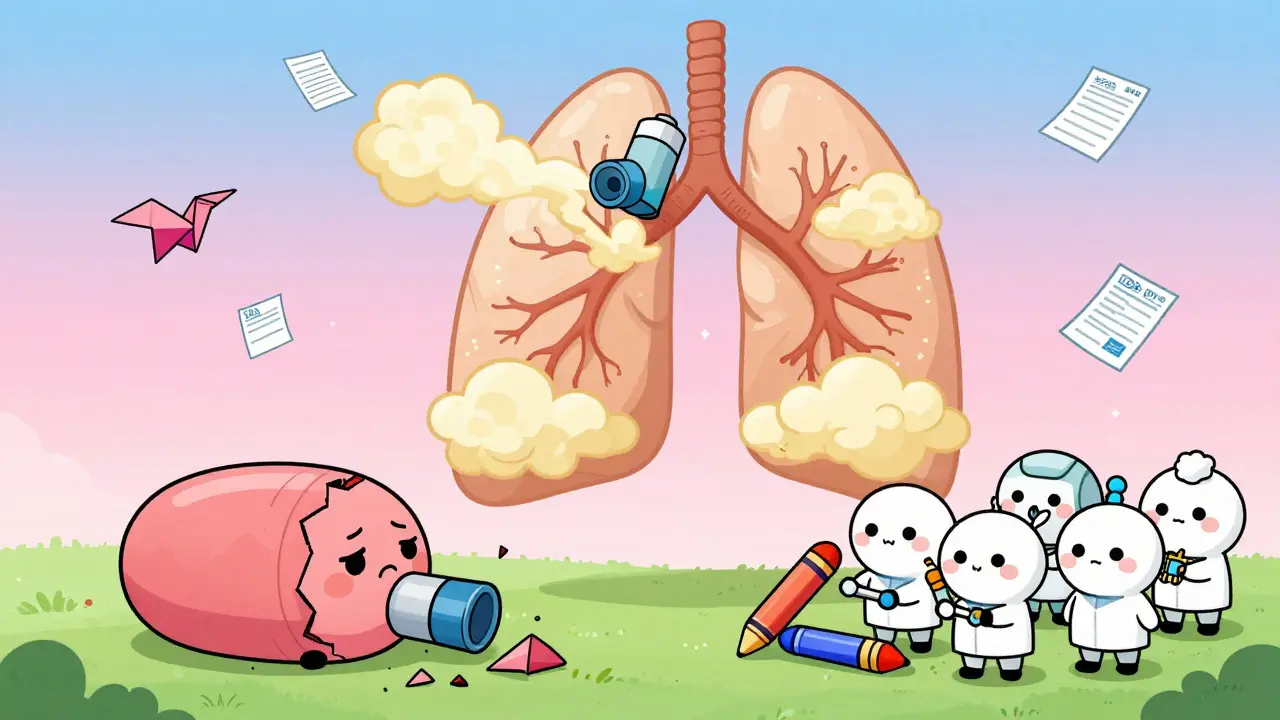
What’s Being Done to Fix It
The FDA knows the problem. They’ve created the Complex Generic Drug Products Committee and launched a dedicated development program. Since 2022, they’ve published 15 new guidance documents covering everything from topical corticosteroids to testosterone gels and inhaled budesonide. They’re investing in new tools:- Physiologically-based pharmacokinetic (PBPK) modeling-using computer simulations to predict how a drug behaves in the body based on its physical properties, not just blood levels.
- In vitro lung deposition models-lab tests that mimic how an inhaler delivers drug to the lungs.
- Advanced imaging-using fluorescent tags and microscopy to track how a cream penetrates skin layers.
The Future: More Innovation, More Access
The market for complex generics is huge. In the U.S. alone, it’s worth $120 billion. Sales are projected to grow from $15 billion in 2023 to $45 billion by 2028. That’s a 24.6% annual growth rate. Why? Because patients and payers are demanding cheaper alternatives. Insurers won’t keep paying $1,000 for an inhaler when the brand patent expired five years ago. And as new analytical methods become standardized-especially through international efforts like ICH Q3D for impurity control-approval pathways will become clearer. But the road ahead is still steep. As one leading scientist put it: "Even small manufacturing changes can have outsized effects on product performance." That means every batch, every lot, every new production line must be scrutinized with unprecedented rigor. The goal isn’t just to copy a drug. It’s to replicate its behavior-down to the last micron of particle size, the last drop of emulsion, the last puff of aerosol. That’s not just science. It’s engineering at its most demanding.What This Means for Patients
You might not think about the chemistry behind your inhaler or cream. But it matters. When complex generics aren’t available, you pay more. You might wait longer for treatment. You might get stuck with a product that doesn’t work as well because it’s the only option. The slow pace of complex generic approvals isn’t just a regulatory issue-it’s a public health issue. Every year that a life-changing drug stays brand-only, thousands of patients face financial strain or reduced access. But progress is happening. The tools are improving. The science is catching up. And with each new guidance, each new testing method, each successful approval, the door opens a little wider for affordable, effective alternatives. The next time you see a generic drug on the shelf, remember: for most pills, it’s simple. But for the complex ones? Someone spent years trying to crack a puzzle no one had a complete picture of. And they’re still working on it.Why can’t we just use blood tests for all generic drugs?
Blood tests only work when the drug needs to enter the bloodstream to have an effect. For complex generics like inhalers, topical creams, or eye drops, the drug is meant to act locally-on the lungs, skin, or eye. Measuring blood levels doesn’t tell you if the drug reached the right place or worked as intended. That’s why new methods like imaging, in vitro models, and computer simulations are being developed.
How long does it take to develop a complex generic compared to a regular one?
Developing a complex generic typically takes 18 to 24 months longer than a traditional generic. While a simple generic might take 2-3 years from start to approval, a complex one often requires 4-5 years or more. This is due to the need for advanced characterization, multiple stability studies, and often multiple rounds of testing because initial methods fail.
Why do complex generics cost more to develop?
Complex generics require specialized equipment, highly trained scientists, and extensive testing that isn’t needed for simple drugs. Manufacturers must reverse-engineer the brand product without knowing its formula, run dozens of stability tests under different conditions, and develop custom analytical methods for each product. These steps are expensive and time-consuming, and many attempts fail before approval.
Are complex generics less safe than brand-name drugs?
No. Once approved, complex generics are required to meet the same safety and quality standards as brand-name drugs. The FDA only approves them after confirming they are therapeutically equivalent. The challenge isn’t safety-it’s proving equivalence with current scientific tools. Many complex generics on the market today are as safe and effective as their brand counterparts.
What’s being done to speed up approval of complex generics?
The FDA is developing new scientific tools like PBPK modeling, advanced imaging for skin penetration, and standardized in vitro tests for inhalers and topical products. They’ve also created a dedicated program for early engagement with manufacturers, which increases approval rates by 35%. International efforts, like ICH guidelines, are helping align global standards, reducing duplication and delays.
Can a complex generic ever be approved without human trials?
Yes, in some cases. For certain complex products, the FDA now accepts data from advanced in vitro tests, computer models, and detailed product characterization instead of full human bioequivalence studies. This is especially true for products where measuring blood levels is meaningless. PBPK modeling, for example, can predict how a drug behaves in the body based on its physical properties, reducing or eliminating the need for human testing.
LALITA KUDIYA
January 7, 2026 AT 06:53Emma Addison Thomas
January 8, 2026 AT 21:39Alex Danner
January 9, 2026 AT 21:06Rachel Steward
January 10, 2026 AT 10:01Paul Mason
January 11, 2026 AT 11:44steve rumsford
January 12, 2026 AT 04:09Aparna karwande
January 13, 2026 AT 06:12Anthony Capunong
January 14, 2026 AT 02:26Jonathan Larson
January 14, 2026 AT 06:36Katrina Morris
January 14, 2026 AT 21:55Ayodeji Williams
January 15, 2026 AT 02:54Anastasia Novak
January 15, 2026 AT 08:08Sai Ganesh
January 17, 2026 AT 03:33Andrew N
January 18, 2026 AT 10:05Kamlesh Chauhan
January 19, 2026 AT 08:21