
 Dec, 22 2025

One glass of grapefruit juice can turn a safe medication into a dangerous one. It’s not a myth. It’s not a warning you can ignore. For people taking certain prescription drugs, drinking grapefruit juice-even once-can lead to toxic drug levels in the blood, muscle breakdown, kidney failure, or even a fatal heart rhythm problem. This isn’t about eating too much fruit. It’s about a powerful, hidden chemical reaction between your medicine and something many people think is healthy.
Why Grapefruit Juice Is Different from Other Juices
Most food interactions are about stomach upset or reduced absorption. Grapefruit juice doesn’t work that way. It doesn’t make your pill less effective. It makes it more powerful-sometimes dangerously so. The culprit? Furanocoumarins. These are natural chemicals found in grapefruit, especially in the peel and pulp. When you drink grapefruit juice, these compounds shut down an enzyme in your gut called CYP3A4. This enzyme is responsible for breaking down about half of all oral medications before they even reach your bloodstream. When it’s blocked, the drug slips through untouched, flooding your body with more than it should have. What makes this worse is that the effect lasts days. One glass of juice can inhibit CYP3A4 for up to 72 hours. So even if you take your pill in the morning and drink juice at night, you’re still at risk. The FDA says you must avoid grapefruit the whole time you’re on these medications-not just around the time you take your dose.Which Medications Are Most at Risk?
More than 85 prescription drugs are known to interact with grapefruit juice. But not all are equally dangerous. Some can cause life-threatening side effects. Others just raise your risk slightly. Here are the biggest concerns:- Statins (cholesterol drugs): Simvastatin (Zocor) is the worst offender. Just 200 mL of grapefruit juice daily for three days can triple its blood levels. That raises the risk of rhabdomyolysis-a condition where muscle tissue breaks down and can damage your kidneys. Atorvastatin (Lipitor) has a milder interaction. But pravastatin and rosuvastatin? No problem. If you’re on simvastatin, switching to one of these is often the safest fix.
- Calcium channel blockers (blood pressure meds): Felodipine (Plendil) and nifedipine (Procardia) can see their levels jump 3 to 5 times higher. That can drop your blood pressure too low, cause dizziness, fainting, or even heart failure. Amlodipine (Norvasc) is safe. The difference matters.
- Immunosuppressants: Cyclosporine (Neoral), used after transplants, can spike 50-60% in concentration. That raises the risk of kidney damage. Tacrolimus is a safer alternative for many patients.
- Antiarrhythmics: Amiodarone (Cordarone) can build up to dangerous levels, increasing the chance of irregular heartbeats that could be fatal.
- Some psychiatric drugs: Certain benzodiazepines and sedatives like triazolam can cause extreme drowsiness or breathing problems. But others, like trazodone and zolpidem, show little to no interaction.
What About Other Citrus Fruits?
Not all citrus is the same. Seville oranges (used in marmalade) and pomelos contain the same furanocoumarins as grapefruit. So if you’re on a risky medication, skip those too. Sweet oranges (like navel or Valencia), tangerines, lemons, and limes? Safe. They don’t contain the harmful compounds. You can still enjoy orange juice with your pills. Just avoid anything labeled “grapefruit,” “pomelo,” or “Seville orange.”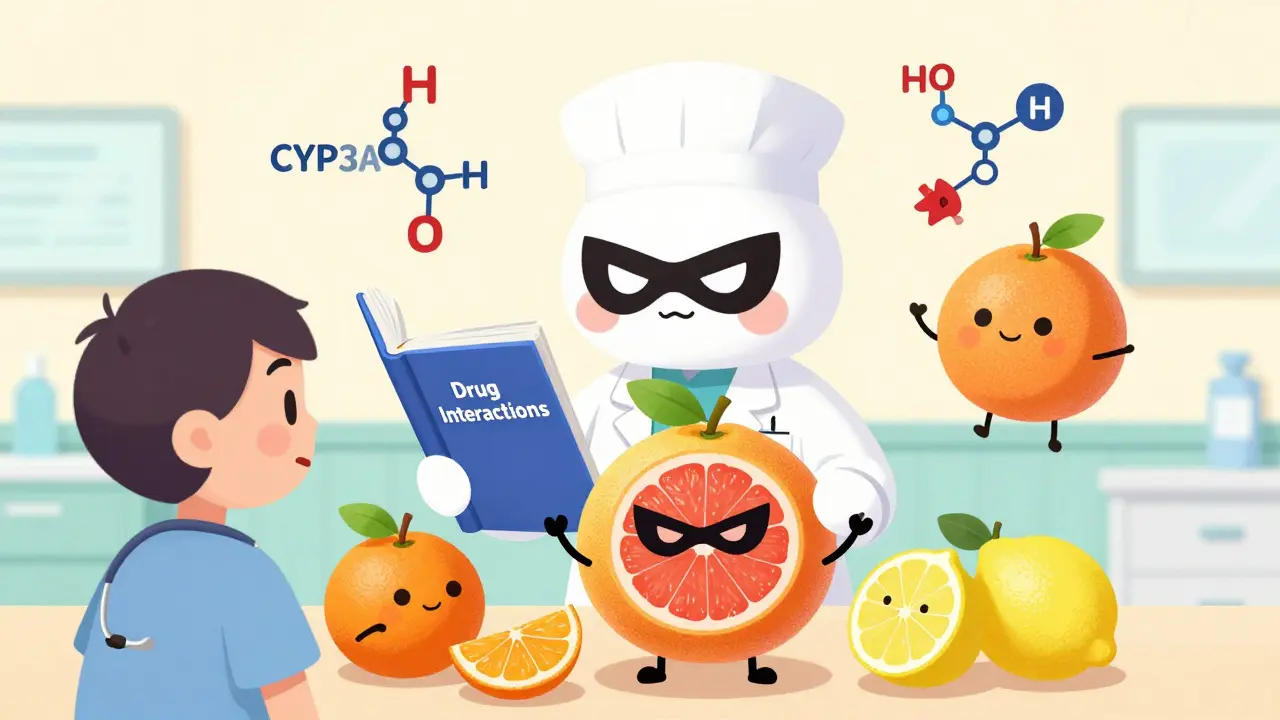
Why Some People Are More at Risk
Not everyone reacts the same way. In one study, some people had zero increase in drug levels after drinking grapefruit juice. Others saw their levels jump eightfold. Why? It comes down to your genes. Some people naturally have more CYP3A4 enzymes in their gut. When grapefruit shuts those down, the impact is bigger. Others have less to begin with-so the juice doesn’t change much. There’s no test to find out which group you’re in. That’s why doctors don’t try to guess. They just say: avoid it. Older adults are especially vulnerable. People over 65 make up 40% of grapefruit juice drinkers in the U.S. and take an average of 3-5 medications daily. Many of those meds are on the dangerous list. The American Geriatrics Society warns this group to be extra careful.What Should You Do?
Step 1: Check your meds. Look at the prescription label. If it says “avoid grapefruit” or “do not consume grapefruit products,” follow it. Step 2: Ask your pharmacist. They’re trained to spot these interactions. A 2021 study found that 89% of community pharmacists screen for grapefruit interactions when dispensing meds. Don’t assume they’ll tell you-ask. Step 3: Make a full list. Include every prescription, over-the-counter drug, and supplement. Some OTC meds, like certain antihistamines (fexofenadine/Allegra), also interact. Don’t forget herbal products-some contain compounds that affect the same enzyme. Step 4: Talk to your doctor. If you’re on a high-risk drug like simvastatin or cyclosporine, ask if there’s a safer alternative. Switching from simvastatin to pravastatin isn’t just a minor change-it can eliminate a life-threatening risk.
bharath vinay
December 23, 2025 AT 08:46This is all corporate propaganda. The FDA doesn't care about your health-they care about patent extensions. Grapefruit juice has been used for centuries in traditional medicine. The real danger is Big Pharma pushing synthetic alternatives to keep you hooked on expensive pills. They don't want you to know that nature already fixed your problem. They just need you to keep buying.
And don't even get me started on CRISPR-edited grapefruit. That's not science-it's corporate control disguised as innovation. Next they'll gene-edit your coffee to make you dependent on their patented beans.
Stop trusting institutions. Start trusting your body. I've been drinking grapefruit juice with my statins for five years. Still standing. Still breathing. Still not paying $500 a month for a pill that could've been replaced by fruit.
They call this 'science.' I call it fearmongering with a lab coat.
And yes, I know what you're going to say. You're going to quote studies. I've read them. They're funded by the same companies that make the drugs. Same money. Same lie.
Wake up.
Dan Gaytan
December 23, 2025 AT 10:41This is such an important post 🙏 I literally just found out my dad was drinking grapefruit juice with his blood pressure med and had no idea. We're going to the pharmacy tomorrow to get it checked. Thank you for breaking this down so clearly-so many people are at risk and don't even know it. Seriously, share this with your family. It could save a life.
Also, orange juice is still your friend 😊
Chris Buchanan
December 23, 2025 AT 16:08So let me get this straight-you’re telling me I can’t have my morning grapefruit smoothie with my Lipitor? Bro, I just bought a whole case of that juice last week. You’re telling me I’m one sip away from turning into a human muscle melt? 😅
Okay, fine. I’ll switch to orange juice. But I’m holding a grudge. That juice was delicious. And now I have to explain to my 87-year-old aunt why she can’t have her ‘healthy habit’ anymore. She’s gonna cry. I’m gonna cry. The grocery store’s gonna cry.
Also, can we talk about how wild it is that the same enzyme that breaks down my meds also breaks down the grapefruit? Like, nature’s got a sense of humor. ‘Hey, here’s a fruit that’s supposed to be good for you-oh wait, it’s also a silent assassin.’
Anyway, thanks for the heads-up. I’m updating my meds list right now. And yes, I’m printing it out. On paper. Like a real adult.
Spencer Garcia
December 24, 2025 AT 21:46Switching from simvastatin to pravastatin is the easiest fix. No need to panic. Just ask your doctor. Most insurance covers it. Same benefit, zero risk.
Also, if you're on cyclosporine or amiodarone-don't wait. Talk to your pharmacist today. This isn't theoretical. People die from this.
And yes, Seville oranges count. Pomelos too. Read labels.
Orange juice? Safe. Lemon water? Safe. Just avoid anything labeled grapefruit or pomelo.
Lindsey Kidd
December 25, 2025 AT 09:27Thank you for writing this. I work with seniors and I see this every week. Someone will say, 'But my neighbor drinks grapefruit juice with her pills!' and I just smile and say, 'Let's check your list together.'
So many people feel guilty about giving up their favorite juice. But they don’t realize it’s not about deprivation-it’s about safety. You can still have citrus! Just not that kind.
And if you're worried about taste-try adding a splash of lime to sparkling water. It’s refreshing and 100% safe 😊
You’re not alone. We’ve got you.
Austin LeBlanc
December 26, 2025 AT 00:55You people are pathetic. You let a fruit scare you into taking whatever Big Pharma tells you. I’ve been on 8 different meds for 12 years. I drink grapefruit juice every morning. I’ve never had a problem. You think your body’s that weak?
And you’re all running to the pharmacist like it’s a cult meeting. Get a grip. Your anxiety is worse than the juice.
Also, CRISPR grapefruit? That’s the future. The future is science. Not fear. Stop being sheep.
And if you’re over 65 and still drinking juice? Good for you. You’re living longer than these scared millennials.
Blow Job
December 26, 2025 AT 10:33My dad took cyclosporine after his transplant. We found out by accident-he’d been drinking grapefruit juice for years. He didn’t even know it was a problem. One blood test later and his levels were through the roof.
He switched to tacrolimus. No issues since. No hospital visits. No muscle breakdown. No scary ER trips.
It’s not about being paranoid. It’s about being informed. Your pharmacist isn’t trying to sell you something-they’re trying to keep you alive.
And yeah, it’s weird that a fruit can do this. But biology doesn’t care how ‘healthy’ you think something is.
Just check your meds. Seriously. Do it now.
Christine Détraz
December 26, 2025 AT 11:11I’ve been on statins for 7 years and I never knew about this until I read this post. I’ve been drinking grapefruit juice every day. I’m not panicking but I’m definitely stopping tonight.
I’m glad the article didn’t just say ‘avoid everything’-it gave alternatives. That’s helpful. I can still have my citrus, just not that one kind.
Also, I love that they mentioned the gene thing. Makes sense why some people are fine and others aren’t. We’re all different.
Thanks for writing this. I feel smarter now.
John Pearce CP
December 28, 2025 AT 02:29It is a matter of national security that American citizens are not properly educated regarding pharmaceutical interactions with common dietary substances. The proliferation of misinformation, particularly propagated by social media platforms and unregulated health influencers, has resulted in a public health crisis of epic proportions.
The United States Department of Health and Human Services must institute mandatory labeling protocols for all citrus products containing furanocoumarins. Furthermore, pharmacists should be required to conduct verbal counseling upon dispensing any medication on the high-risk interaction list.
The fact that 40% of grapefruit juice consumers are over the age of 65 and concurrently taking three to five medications is not merely a statistical anomaly-it is a systemic failure of the American healthcare infrastructure.
Until such time as CRISPR-modified citrus is federally approved and distributed, the only responsible course of action is complete abstinence from grapefruit and pomelo products when under pharmacological treatment.
This is not an opinion. It is a clinical imperative.
Let us not allow the convenience of taste to supersede the sanctity of life.
Jillian Angus
December 28, 2025 AT 04:36