
 Jan, 21 2026

When a pill turns yellow, a cream separates into layers, or a liquid smells funny, it’s not just a weird quirk-it could be a warning sign that the medicine has broken down. Expired drugs don’t just lose potency. They can change physically in ways that make them unsafe. You don’t need a lab to spot these changes. With a little knowledge and a sharp eye, you can tell if something’s off before you take it.
What Changes to Look For
The most common red flag is color. A white tablet turning light brown, especially around the edges, is a classic sign of degradation. Tetracycline antibiotics are notorious for this-they go from pale yellow to dark brown as they break down. Even clear liquids like eye drops or cough syrup can turn cloudy or yellow. Nitroglycerin, for example, turns from clear to a yellow-brown hue when it degrades, losing its ability to work properly.
Odor is another clue. Most pills and capsules are odorless. If you open a bottle and smell something sour, musty, or chemical-like vinegar or ammonia-it’s not normal. Some antibiotics, like amoxicillin, absorb moisture and start to smell stale. Creams and ointments that smell rancid or like old oil have likely gone bad. A foul odor means chemical reactions are happening inside, and the active ingredient may no longer be reliable.
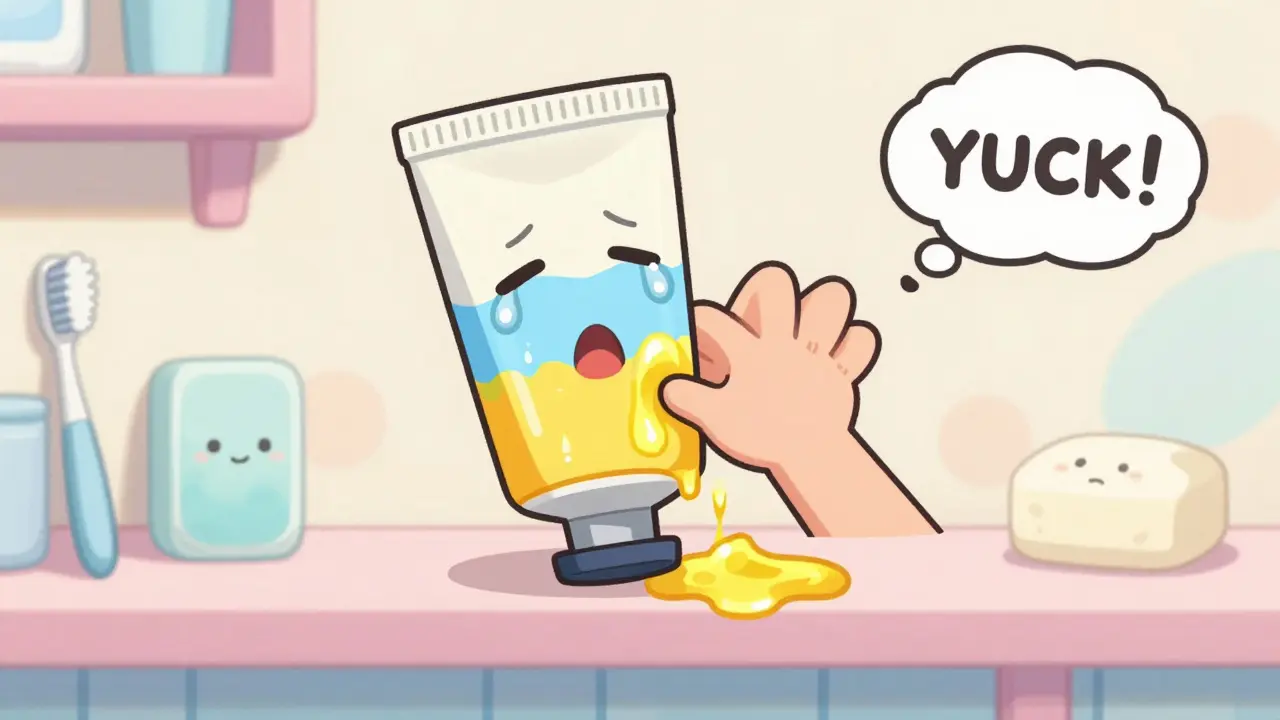
Texture changes are harder to miss. Tablets that crumble in your fingers, capsules that stick together or feel gummy, or creams that separate into oily and watery layers are all signs of failure. If your hydrocortisone cream looks like it has oil floating on top or has turned grainy, it’s no longer stable. Liquids with visible particles, floating specks, or a thick, syrupy consistency that wasn’t there before are also dangerous. These aren’t just cosmetic-they signal that the drug’s structure has broken down.
Why These Changes Matter
These physical changes aren’t just about appearance. They’re signs that the chemical structure of the drug is shifting. When a tablet discolors, it often means the active ingredient is oxidizing or breaking down into harmful byproducts. A cream that separates isn’t just messy-it’s uneven. You might get too much of the drug in one scoop and none in the next. That’s not just ineffective-it’s risky.
Studies show that 68.3% of expired medications show visible discoloration. In solid forms like pills and capsules, that number jumps to 73.5%. For creams and ointments, phase separation happens in nearly 4 out of 10 cases after expiration. And while some changes might look harmless, they often precede chemical degradation. The FDA has documented cases where drugs looked fine but had lost over 30% of their potency. Others changed color long before they lost strength, making visual checks a critical first step.
Worse, some people ignore these signs. One hospital kept using expired morphine sulfate because it had fine crystals-mistaking them for normal sediment. That led to 14 patient adverse events. Another person kept using an expired antibiotic cream because it still looked white. But it had separated, and the active ingredient had settled at the bottom. They applied it unevenly and didn’t get the full dose.
How to Check Your Medications
You don’t need special tools. Just follow these steps:
- Take it out of the bottle. Look at it under good lighting-natural daylight or a bright lamp works best. Avoid dim or yellow-tinted lights.
- Check the color. Compare it to a new, unexpired version if you still have one. If it’s darker, patchy, or has brown spots, don’t use it.
- Smell it. If it smells off-sour, chemical, or rancid-discard it. Trust your nose. Medications shouldn’t have a strong odor.
- Feel it. For pills: Are they brittle? Do they crumble? For capsules: Are they stuck together or swollen? For creams: Does it separate when you squeeze the tube? For liquids: Are there floating bits or cloudiness?
- Check the container. Is the cap warped? Is there moisture inside? That means the seal broke, and the drug was exposed to air or humidity.
Some drugs naturally change slightly. For example, some iron supplements turn darker over time. But if the change is sudden, uneven, or accompanied by odor or texture shifts, it’s not normal. When in doubt, throw it out.
What to Do When You Find a Problem
If you spot a change, stop using the medication immediately. Don’t try to guess if it’s still safe. Even if it’s only a week past the expiration date, physical changes mean you can’t trust its safety or effectiveness.
Take it to a pharmacy. Most will take back expired or damaged drugs for safe disposal. Some even offer free disposal bins. Don’t flush it or toss it in the trash-especially antibiotics or painkillers. That’s bad for the environment and dangerous if someone else finds it.
Report it. If you bought it from a pharmacy and it looked off before expiration, let them know. If it’s a generic drug that changed color unexpectedly, the FDA tracks these reports. Your feedback helps them catch batch issues.
Storage Matters More Than You Think
Even if a drug hasn’t expired, poor storage can make it degrade fast. Heat, humidity, and light are the biggest enemies.
Don’t keep pills in the bathroom. The steam from showers can make them absorb moisture and break down. Don’t leave them in a hot car. Temperatures above 25°C (77°F) can accelerate degradation by more than twice as fast. Store medications in a cool, dry place-like a bedroom drawer, not a kitchen cabinet near the stove.
Keep them in their original bottles. The child-resistant caps and opaque containers aren’t just for safety-they protect from light and moisture. Transfer pills to pill organizers only if you’re using them daily. Don’t leave them in those containers for weeks.
When to Trust the Expiration Date
Expiration dates aren’t arbitrary. They’re based on stability testing done by manufacturers under strict FDA guidelines. The drug must stay within 90-110% potency and show no physical degradation until that date.
But expiration doesn’t mean “immediately dangerous.” Some drugs, like insulin or liquid antibiotics, are time-sensitive and should be discarded exactly on the date. Others, like solid tablets stored properly, may remain stable for months or even years past expiration. But if you see physical changes-color, odor, texture-ignore the date. The signs are already telling you it’s no longer safe.
What’s Changing in the Industry
Hospitals and research labs now use color charts and digital tools to spot changes more accurately. The University of Wisconsin’s RARC program uses colored dot stickers on bottles to track expiration months. Some pharmacies use portable spectrophotometers to measure color shifts down to a single unit.
But for most people, visual inspection is still the most practical tool. The FDA and WHO both agree: if you can see, smell, or feel something wrong, don’t take it. No instrument replaces common sense.
Still, the trend is moving toward more objective tools. Portable Raman spectrometers, which can identify chemical changes without opening the bottle, are becoming cheaper. In a few years, they might be as common as smartphone cameras. But for now, your eyes, nose, and fingers are your best defense.
Final Reminder
Medications aren’t like bread or milk. You can’t always tell if they’re bad just by looking. But when they change color, smell, or texture, that’s your body’s early warning system. Don’t ignore it. Don’t rationalize it. Don’t hope it’s fine.
When in doubt, throw it out. Your health isn’t worth the risk.
Hilary Miller
January 23, 2026 AT 04:37Just threw out my grandma's old antibiotic cream last week-smelled like old cheese. Good thing I read this.
Brenda King
January 25, 2026 AT 00:19I used to keep meds in the bathroom until my pharmacist told me I was basically brewing a science experiment. Now they live in a Tupperware in my nightstand. Game changer.
Also, never trust a pill that looks like it’s been through a sandstorm.
Neil Ellis
January 25, 2026 AT 11:39There’s something deeply poetic about the way medicine betrays you-not with a bang, but with a faint yellow stain on the edge of a tablet, or the ghost of vinegar in a once-innocent cough syrup.
These aren’t just chemical changes-they’re quiet revolutions inside a capsule. The body knows before the label does.
And yet we still reach for them, don’t we? Out of habit. Out of fear. Out of hope.
Maybe that’s why this post matters so much. It doesn’t just warn us-it honors the quiet dignity of our own intuition.
Trust your nose. Trust your fingers. Trust the silence between the expiration date and the truth.
Sarvesh CK
January 25, 2026 AT 19:32While the emphasis on visual and olfactory cues is both practical and commendable, one must also consider the broader epistemological implications of relying on sensory perception in pharmacological contexts. Human perception, though evolved for survival, is inherently fallible and subject to cognitive biases such as confirmation bias and sensory adaptation. For instance, individuals living in environments with high ambient odors may desensitize to subtle chemical changes in medications, thereby increasing risk. Furthermore, the cultural variability in olfactory thresholds-particularly across populations with differing dietary exposures-may affect the reliability of odor-based assessments. A systematic approach integrating both phenomenological observation and standardized visual reference charts, as referenced in the Wisconsin RARC program, would enhance reproducibility. The FDA’s adherence to stability testing protocols remains the gold standard, yet public education must bridge the gap between institutional rigor and layperson accessibility without inducing undue alarm. The notion that expiration dates are absolute is a myth; however, the presence of physical degradation is not a gray area-it is a binary signal of compromised integrity, irrespective of temporal proximity to the labeled date.
Oren Prettyman
January 27, 2026 AT 19:21Let’s be honest-this entire post reads like a pharmaceutical marketing pamphlet disguised as public service. The FDA doesn’t care if your cream separated. They care about liability. And yes, some drugs remain stable for years past expiration-studies from the 1980s and 2000s confirm this. Why are we being fed fear-based content instead of nuanced science? You don’t need to throw out every discolored tablet. You need to understand context. Temperature, humidity, packaging-all matter. And yet, the narrative here reduces complex pharmacology to a checklist of ‘smell it, stare at it, panic.’ This isn’t education. It’s anxiety monetization.
Malik Ronquillo
January 27, 2026 AT 21:37People still take expired meds?? Bro. Just stop. I had a cousin take an old ibuprofen that turned brown and ended up in the ER with stomach bleeding. Not a joke. Your pills aren’t magic. They’re chemicals. And chemicals don’t care how much you believe in them.
Throw it out. Seriously. I’m not even mad. I’m just disappointed.
arun mehta
January 28, 2026 AT 21:20As someone who has spent over two decades managing clinical supply chains across South Asia, I can confirm with absolute certainty that environmental degradation of pharmaceuticals is not a Western problem-it is a global crisis. In rural India, where humidity exceeds 85% for six months annually and refrigeration is a luxury, expired medications are often repurposed due to economic necessity. We have documented cases where tetracycline tablets, exposed to monsoon moisture, turned deep crimson and induced hemolytic reactions in pediatric patients. The solution is not merely individual vigilance but systemic reform: low-cost desiccant sachets distributed with every blister pack, community pharmacy inspection programs, and mobile spectrophotometry units in mobile clinics. Until then, yes-your nose and eyes are your only tools. But let us not romanticize them as sufficient. They are stopgaps in a broken system.
Keith Helm
January 30, 2026 AT 09:53Why are you keeping expired medication at all? If you’re not using it within the expiration window, why did you buy it? This is not a detection guide-it’s a justification manual for hoarding.
Daphne Mallari - Tolentino
January 31, 2026 AT 00:04One must question the pedagogical validity of relying on sensory heuristics in an age of precision diagnostics. The conflation of aesthetic degradation with pharmacological ineffectiveness is not merely reductive-it is epistemologically unsound. The FDA’s 90–110% potency threshold is grounded in chromatographic and spectrophotometric analyses, not the subjective interpretation of a discolored tablet. To suggest that a ‘musty odor’ or ‘grainy texture’ is a sufficient indicator of clinical risk is to elevate anecdotal observation above empirical science. While such cues may serve as heuristic prompts, they must never supplant laboratory validation. One cannot, in good conscience, recommend discarding life-saving therapeutics based on visual cues alone-unless one is prepared to acknowledge the systemic failures that render such cues necessary in the first place.