
 Dec, 9 2025

Imagine you’re struggling with anxiety so severe that you can’t leave the house. At the same time, you’re drinking every night just to quiet the noise in your head. You go to a mental health clinic, and they tell you to see a counselor for your anxiety. Then you go to a substance use program, and they say your depression needs to be handled first. You bounce between two systems that don’t talk to each other. Sound familiar? That’s the reality for most people with dual diagnosis-a term that describes someone living with both a mental illness and a substance use disorder at the same time. And it’s broken.
Why Separate Treatment Doesn’t Work
For decades, the system treated mental health and addiction like two separate problems. You’d get therapy for depression in one building, and detox for alcohol in another. The problem? They’re not separate. Substance use often starts as self-medication. Someone with PTSD might turn to opioids to numb flashbacks. Someone with bipolar disorder might binge on cocaine during manic episodes. When you treat just one side, the other one pulls you back down. Studies show that people who get only one type of care are far more likely to relapse. The Cleveland Clinic reports that about 20.4 million U.S. adults had co-occurring disorders in 2023. Yet only 6% of them got treatment for both. That means over 19 million people are stuck in a cycle: mental health gets worse → they use more substances → their mental health gets even worse.What Integrated Dual Diagnosis Care Actually Is
Integrated Dual Diagnosis Treatment (IDDT) flips the script. Instead of two teams working in silence, you get one team-therapists, psychiatrists, case managers-all trained in both mental illness and addiction. They don’t treat one condition after the other. They treat them together, from day one. This isn’t theory. It’s the gold standard, backed by SAMHSA, Case Western Reserve University, and decades of clinical research. The model was developed in New Hampshire and Dartmouth in the 1990s and has since been proven to reduce substance use days, improve medication adherence, and lower hospitalization rates.IDDT isn’t just about putting two services under one roof. It’s about changing how care is designed. Every assessment screens for both conditions. Every treatment plan includes goals for managing mood swings and reducing drug use. Every counselor knows how to use motivational interviewing-not to push abstinence, but to help people find their own reasons to change. That’s a big deal. Many people aren’t ready to quit cold turkey. IDDT meets them where they are. It’s harm reduction with a clinical backbone.

The Nine Core Components of IDDT
This isn’t a vague approach. IDDT has nine specific, evidence-based practices built into every program:- Motivational interviewing: A conversation style that helps people explore their own reasons for change, not just follow orders.
- Substance abuse counseling: Focused on triggers, cravings, and coping skills-not just abstinence.
- Group treatment: Peer support that connects people with similar struggles, reducing isolation.
- Family psychoeducation: Teaching loved ones how to support recovery without enabling.
- Participation in self-help groups: Encouraging involvement in groups like SMART Recovery or Dual Recovery Anonymous.
- Pharmacological treatment: Using medications like buprenorphine, naltrexone, or antidepressants in a coordinated way.
- Health promotion: Addressing physical health-nutrition, sleep, exercise-that often gets ignored in mental health care.
- Secondary interventions: For people who aren’t responding to standard care, offering more intensive support.
- Relapse prevention: Planning for setbacks, not pretending they won’t happen.
These aren’t optional add-ons. They’re the foundation. A 2018 study in a randomized trial with 37 clinicians found that after IDDT training, patients reduced their substance use days significantly. But here’s the catch: the training didn’t improve clinicians’ skills in motivational interviewing. That’s a warning sign. IDDT only works if the people delivering it are properly trained-and kept trained.
Why Most Programs Still Fail
You’d think with all the evidence, IDDT would be everywhere. But it’s not. Why? Because it’s expensive and hard to implement. Most clinics still operate on old funding models that pay for separate services. Medicaid might cover therapy for depression, but not the same therapist’s time spent helping with addiction. Insurance companies don’t bundle payments. So clinics have to choose: do they hire two staff members for two separate programs, or one person who’s expected to know everything? Too often, they pick the cheaper option-and compromise care.The Washington State Institute for Public Policy found that while IDDT reduces alcohol and drug use symptoms, the benefit-cost ratio is less than 1. That means for every dollar spent, you get back about 50 cents in measurable savings. That doesn’t sound great-until you factor in emergency room visits, jail time, homelessness, and lost productivity. Those costs aren’t counted in most studies. When you add them up, IDDT saves money over time. But short-term budgets don’t care about long-term savings.
Another barrier? Staff burnout. Treating dual diagnosis is emotionally heavy work. Many clinicians never learned how to handle both trauma and addiction in school. They’re expected to be experts overnight. Without ongoing training, supervision, and support, they leave. And when the team changes, the patient loses continuity. That’s why IDDT requires organizational commitment-not just a new brochure.
What Recovery Looks Like in Practice
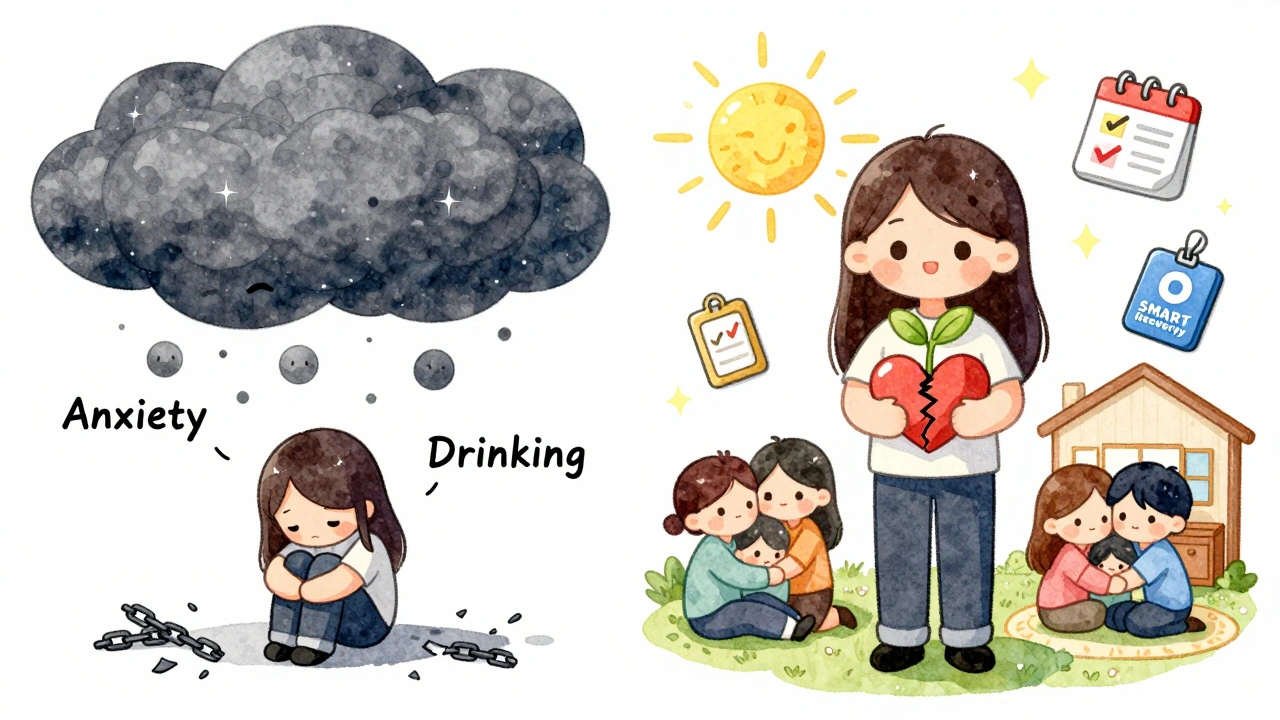
A 32-year-old woman in Texas, let’s call her Maria, had schizophrenia and drank heavily. She was hospitalized three times in a year. Her old treatment plan had her in a psychiatric unit for two weeks, then discharged with a referral to a separate addiction clinic. She never went. With IDDT, she was assigned a single care team. Her psychiatrist adjusted her antipsychotic to reduce cravings. Her counselor helped her identify that drinking made her hallucinations worse. She joined a peer group where others talked about managing voices and staying sober. She didn’t quit drinking overnight. But she started drinking less. She got a job. She moved into stable housing. She stopped going to the ER. That’s not magic. That’s integrated care.People who stick with IDDT report feeling less confused, less judged, and more heard. They don’t have to explain their story twice. They don’t get conflicting advice. One team. One plan. One message: your mental health and your substance use are connected-and we’re here for both.
The Road Ahead
The treatment gap is massive. Over 15 million people with dual diagnosis aren’t getting the care they need. But change is coming. Medicaid expansion in many states now supports integrated services. The Substance Abuse and Mental Health Services Administration (SAMHSA) is pushing for more state grants to build IDDT capacity. The Co-Occurring Center of Excellence provides free training materials to clinics across the country. The tools exist. What’s missing is funding, training, and political will.For people living with dual diagnosis, the choice isn’t between abstinence and relapse. It’s between being treated like two separate problems-or being treated like a whole person. Integrated care isn’t just better. It’s the only way forward.
Aileen Ferris
December 10, 2025 AT 07:34Michelle Edwards
December 10, 2025 AT 08:33Regan Mears
December 10, 2025 AT 19:55Sarah Clifford
December 12, 2025 AT 11:34Stephanie Maillet
December 12, 2025 AT 21:15Doris Lee
December 14, 2025 AT 13:38Queenie Chan
December 14, 2025 AT 14:54David Palmer
December 16, 2025 AT 07:15Regan Mears
December 18, 2025 AT 02:41Raj Rsvpraj
December 20, 2025 AT 02:15Jack Appleby
December 21, 2025 AT 23:15Nikki Smellie
December 23, 2025 AT 00:20Michaux Hyatt
December 24, 2025 AT 15:28