
 Mar, 16 2026

Steroid Injection Risk Calculator
How This Tool Works
Based on medical studies including a 2023 Boston University study tracking over 1,000 patients, this calculator estimates your relative risk of joint damage and systemic side effects from intra-articular steroid injections. Enter your injection history and patient factors to see personalized risk assessment.
When you have a painful knee or hip from arthritis, an intra-articular steroid injection can feel like a lifeline. Pain eases in days, mobility improves, and you can get back to walking, gardening, or playing with grandkids. But what if that quick fix is quietly doing more harm than good? New research is challenging the long-held belief that these injections are harmless-especially when used often or in younger patients with mild joint damage.
How Intra-Articular Steroid Injections Work
These injections deliver corticosteroids-powerful anti-inflammatory drugs-directly into the joint space. Common types include triamcinolone acetonide, methylprednisolone acetate, and betamethasone. Doses vary: 10 to 80 mg, depending on the joint. The goal is simple: reduce swelling and pain at the source without flooding your whole body with steroids.
For decades, this approach made sense. Corticosteroids were first injected into joints in the 1950s after Nobel Prize-winning work by Philip S. Hench. Since then, over 12 million of these injections have been done annually in the U.S. alone. Many doctors still treat them as routine, low-risk procedures. But recent studies are revealing a darker side.
The Hidden Systemic Side Effects
Here’s the catch: steroids don’t stay in the joint. They leak out. Even when injected perfectly, a portion enters your bloodstream. And once it does, it affects more than just your knee.
Systemic side effects are real-and they’re not rare. Studies show that after an injection, patients can experience:
- High blood sugar-especially dangerous for people with diabetes. Blood glucose can spike for days, sometimes requiring insulin adjustments.
- Adrenal suppression-your body’s natural cortisol production drops. This can cause fatigue, dizziness, or even life-threatening adrenal crisis if you stop steroids suddenly.
- Fluid retention and high blood pressure-common in patients with heart conditions or kidney issues.
- Osteoporosis-bone density drops over time with repeated use, increasing fracture risk.
- Cushing-like symptoms-facial puffiness, weight gain around the midsection, thinning skin. These aren’t just cosmetic. They signal your body’s hormonal balance is off.
The Cleveland Clinic and Mayo Clinic both warn that these risks grow with each additional injection. A 2023 review in the American Journal of Roentgenology found that patients who received multiple injections over time had measurable drops in cortisol levels, indicating long-term disruption of the stress-response system.
Accelerated Joint Damage: The Shocking Truth
Maybe the biggest surprise? These injections might be making your joint arthritis worse.
A landmark 2023 study led by Dr. Ali Guermazi at Boston University tracked over 1,000 patients with knee and hip osteoarthritis. The findings were startling:
- Patients who got injections had 3.2 times higher odds of joint space narrowing on X-rays compared to those who didn’t.
- Those who received repeat injections saw odds jump to 4.67 times higher.
- 44% of patients with hip injections showed measurable joint space loss within just 6 months.
- Some developed subchondral insufficiency fractures-tiny cracks in the bone under the cartilage.
- Others showed signs of osteonecrosis, where bone tissue dies due to poor blood flow.
Dr. Guermazi put it plainly: “We’ve been telling patients that even if these injections don’t relieve your pain, they’re not going to hurt you. But now we suspect that this is not necessarily the case.”
This isn’t just theory. Radiologists now see these patterns on MRI and X-ray scans with growing frequency. The damage isn’t always visible right away. It builds slowly-like a leak in a pipe you didn’t know existed.

Who’s Most at Risk?
Not everyone is equally vulnerable. Certain groups face higher danger:
- People with diabetes-even one injection can throw blood sugar control off for days.
- Postmenopausal women-lower estrogen means lower bone density. Steroids make it worse.
- Younger patients with mild arthritis-if your joint damage is still early, you have decades ahead. Each injection may shorten that timeline.
- Those on oral steroids-adding injections on top of pills multiplies your total steroid load.
- Patients planning surgery-steroids can delay healing and increase infection risk after joint replacement.
Even minor side effects matter. Some patients report a temporary metallic taste after injection. Others get a flare-up-pain and swelling that spikes 24 to 36 hours after the shot. It usually fades, but it’s a warning sign your body is reacting.
What Do the Guidelines Say?
Here’s where things get messy. The American Academy of Orthopaedic Surgeons still conditionally recommends steroid injections for knee osteoarthritis. Many clinics continue offering them as a standard option. But awareness is shifting.
The Journal of the American Academy of Physical Medicine and Rehabilitation (PM&R) now advises caution. They recommend limiting injections to 3 to 4 per year per joint. Some institutions cap it at 2. The rationale? Cumulative exposure matters. A 2018 review found that total steroid dose-including all local injections-should be counted like oral doses when assessing risk.
And here’s the kicker: some studies disagree. A 2023 NIH debate article points out that not every trial shows cartilage loss. One study by Dr. Raynauld found no joint space narrowing on X-rays. Another found cartilage thinning on MRI but no bone damage.
So why the contradiction? Because joint damage is complex. It depends on the drug used, the dose, how often you get shots, your age, your weight, your genetics, and even your activity level. There’s no one-size-fits-all answer.
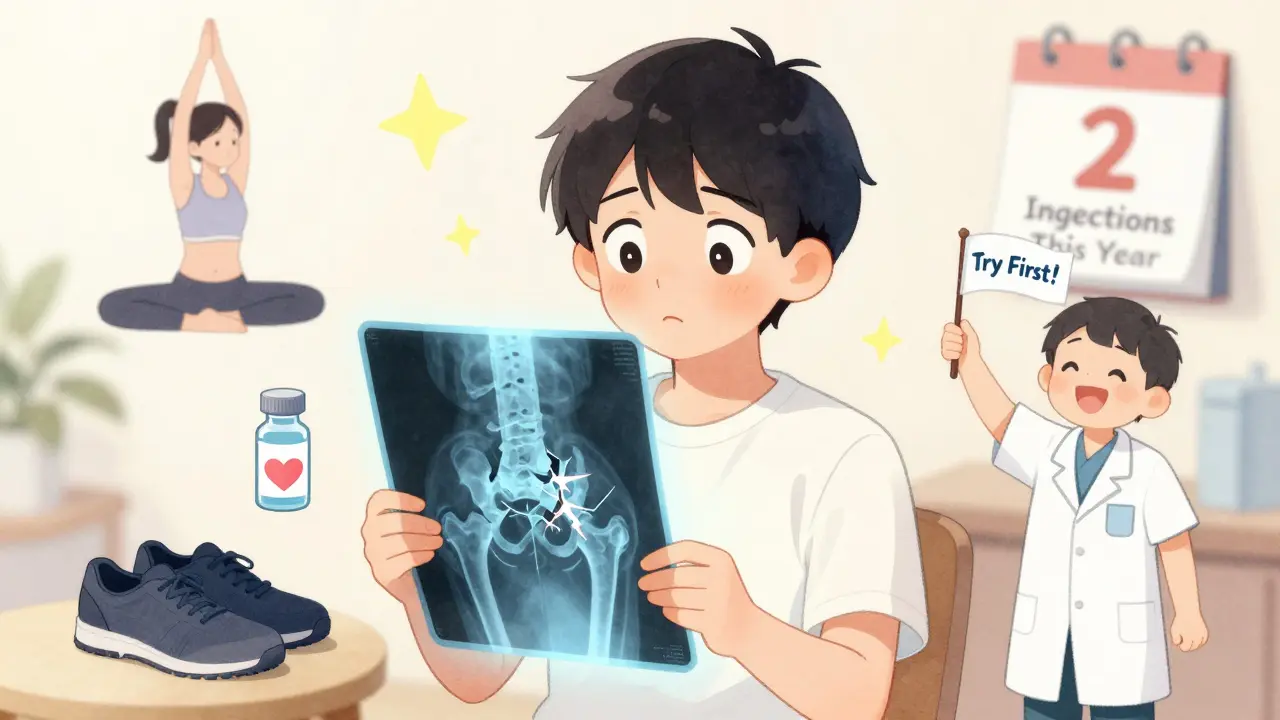
When to Avoid These Injections
There are clear red flags:
- Your pain doesn’t match your X-ray. Mild arthritis on the scan but severe pain? That’s a warning. Something else might be going on-like inflammation from another source.
- You’ve had more than 2 injections in the past year.
- You’re under 50 and have early-stage osteoarthritis.
- You’re diabetic and struggling to control blood sugar.
- You’re planning joint surgery within the next 6 months.
If any of these apply, talk to your doctor about alternatives. Physical therapy, weight loss, bracing, or even newer injectables like hyaluronic acid may offer safer, longer-lasting relief.
The Bottom Line
Intra-articular steroid injections aren’t evil. For many people, they’re a necessary tool. But they’re not harmless. The idea that these shots are just a local fix is outdated. They affect your whole body-and they can speed up joint damage over time.
The best approach? Use them sparingly. Think of them as a temporary pause button, not a cure. If you’ve had more than two in a year, ask: Is this still helping? Or is it just masking a deeper problem?
And if you’re diabetic, postmenopausal, or younger with early arthritis? Push for a second opinion. There are other ways to manage pain without risking your bones, your metabolism, or your future joint health.
Are intra-articular steroid injections safe for people with diabetes?
No, they carry significant risk. Corticosteroid injections can raise blood sugar levels for several days, sometimes requiring insulin adjustments. Patients with diabetes should monitor glucose closely after injection and discuss alternatives with their doctor, especially if they’ve had multiple shots. The risk of prolonged hyperglycemia increases with repeated use.
How many steroid injections are safe per year?
Most guidelines recommend no more than 3 to 4 injections per joint per year. Some experts limit it to 2, especially for younger patients or those with early osteoarthritis. The total cumulative dose-including all injections and oral steroids-matters more than the number of shots. Exceeding this limit raises the risk of systemic side effects and joint damage.
Do steroid injections cause cartilage damage?
Yes, multiple studies now link repeated corticosteroid injections to accelerated cartilage loss and joint space narrowing. A 2023 study found patients with knee injections had over 3 times higher odds of radiographic progression. The damage is often subtle at first-visible on MRI or X-ray over time-but can lead to faster joint deterioration and earlier need for replacement.
Can steroid injections cause bone death (osteonecrosis)?
Yes. Research from the American Journal of Roentgenology (2024) documented cases of osteonecrosis following intra-articular steroid injections, particularly in the hip and knee. This occurs when blood flow to bone tissue is disrupted, leading to tissue death. While rare-occurring in about 1% of long-term users-it’s a serious complication that can lead to joint collapse and require surgery.
What are the alternatives to steroid injections for joint pain?
Alternatives include physical therapy, weight management, braces, low-impact exercise, and non-steroidal anti-inflammatory drugs (NSAIDs). Hyaluronic acid injections may help some patients, though evidence is mixed. Emerging options like platelet-rich plasma (PRP) and stem cell therapies are being studied, but long-term data is still limited. For early arthritis, lifestyle changes often outperform injections in preserving joint health over time.
Stephen Habegger
March 17, 2026 AT 19:12jared baker
March 19, 2026 AT 00:42Michelle Jackson
March 20, 2026 AT 21:32Suchi G.
March 22, 2026 AT 06:39becca roberts
March 22, 2026 AT 17:44gemeika hernandez
March 23, 2026 AT 05:23Nicole Blain
March 23, 2026 AT 07:50Kathy Underhill
March 24, 2026 AT 04:03Andrew Muchmore
March 25, 2026 AT 11:26Paul Ratliff
March 26, 2026 AT 08:57SNEHA GUPTA
March 27, 2026 AT 21:08Gaurav Kumar
March 29, 2026 AT 21:03David Robinson
March 30, 2026 AT 03:29