
 Mar, 2 2026

Levothyroxine and Iron Timing Calculator
This tool helps you determine if your current timing between levothyroxine and iron supplements meets the critical 4-hour separation requirement. The article explains that taking them too close together can reduce levothyroxine absorption by up to 39%, potentially throwing your thyroid treatment off track.
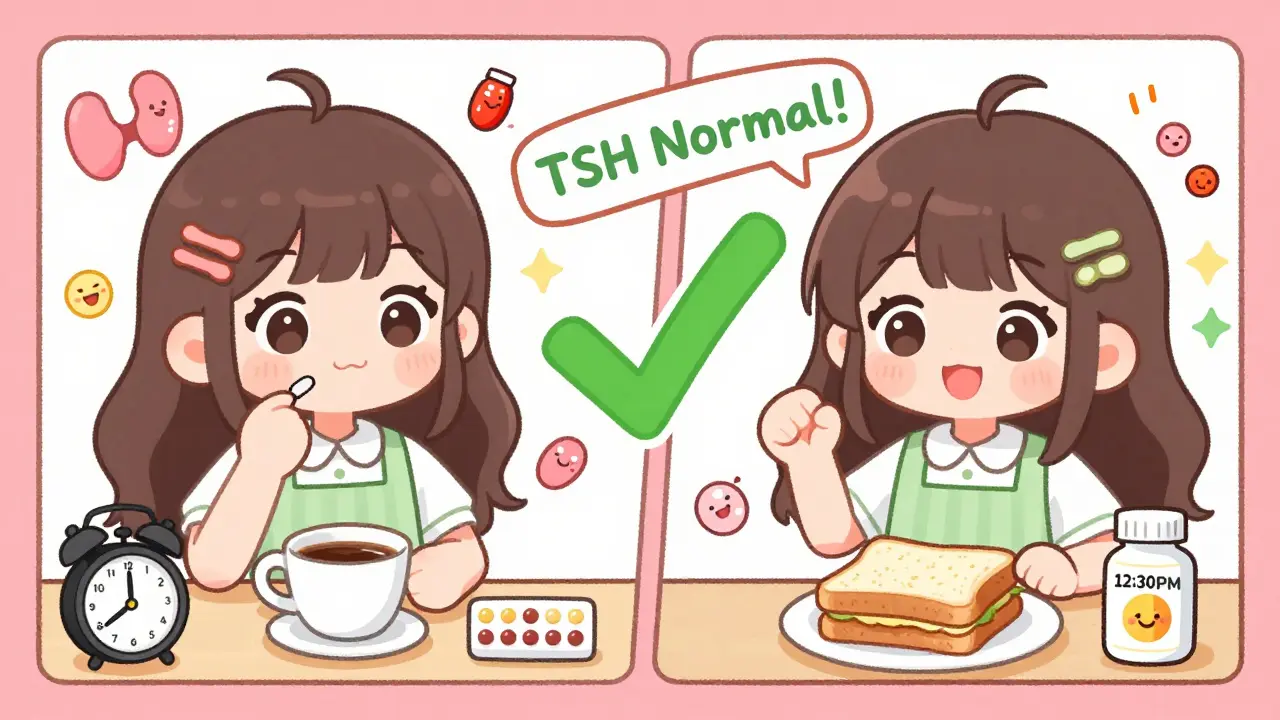
Pro Tip: For best results, take levothyroxine on an empty stomach in the morning, then wait 30-60 minutes before eating. Take iron supplements at least 4 hours later (such as at lunchtime).
If you're taking levothyroxine for hypothyroidism and also need iron supplements, you're not alone. Millions of people do this every day. But here’s the problem: if you take them at the same time, your body might not absorb the thyroid medication properly. And that can throw your whole treatment off track. You might feel more tired, gain weight, or notice your cold intolerance getting worse-even though you're doing everything else right.
This isn't a myth or a guess. It's backed by decades of clinical research. The interaction between iron and levothyroxine is one of the most well-documented drug-supplement conflicts in endocrinology. Studies show iron can reduce levothyroxine absorption by up to 39%. That’s not a small drop. That’s enough to push your TSH levels from normal into the hypothyroid range. And once that happens, your doctor might think your dose is too low and increase it unnecessarily. You could end up on a higher dose than you actually need, just because iron was blocking absorption.
Why Iron and Levothyroxine Don’t Mix
Levothyroxine is absorbed in the upper part of your small intestine. It needs an acidic environment to dissolve properly. Iron supplements-especially ferrous sulfate, the most common form-also need acid to be absorbed. But when they meet in your gut, they bind together like magnets. They form a thick, insoluble complex that your body can’t break down. That complex just passes through you, taking the thyroid hormone with it.
It’s not just about the iron. Other minerals like calcium, magnesium, and aluminum (found in antacids) do the same thing. But iron is the most common offender because so many people need it-especially women, older adults, and those with chronic conditions. A 2023 study found that nearly 28% of people taking levothyroxine were also taking iron supplements. That’s almost one in three. And according to a 2025 audit from the UK NHS, 84% of those patients had no timing instructions at all.
The 4-Hour Rule: What the Experts Say
Most major medical guidelines agree: separate iron and levothyroxine by at least four hours. The British National Formulary (BNF), NICE guidelines, MedlinePlus, and even Synthroid’s official prescribing information all say the same thing. The reason? Consistency. Your gut doesn’t work the same way every day. Transit time changes based on food, stress, illness, or even how much water you drank. Four hours gives you a buffer.
Some sources, like Thyroid UK, suggest two hours might be enough. But that’s based on ideal conditions-fasting, no digestive issues, no other medications. In real life? It’s risky. A 2022 study showed that patients who waited four hours had their TSH levels in target range 89% of the time. Those who didn’t? Only 62%. That’s a huge difference in how well your treatment works.
Dr. Jacqueline Jonklaas, a leading endocrinologist, put it plainly: “I’ve seen TSH levels double in patients who take iron with their thyroid medication.” That’s not a minor fluctuation. That’s a clinical emergency waiting to happen.
When to Take Each One: Real-Life Timing Strategies
So how do you actually do this? Let’s break it down into two proven, practical routines.
Option 1: Morning Levothyroxine, Afternoon Iron
- Take levothyroxine first thing in the morning, on an empty stomach, with a full glass of water.
- Wait 30 to 60 minutes before eating or drinking anything else.
- Take your iron supplement at lunchtime, around 12:30 to 1 PM.
This gives you a clean 5-6 hour gap. It’s simple, reliable, and fits into most people’s daily rhythms. If you take iron with food to avoid nausea (which 65% of people do), lunchtime works perfectly.
Option 2: Bedtime Levothyroxine, Morning Iron
- Take your iron supplement right after waking up, with breakfast or a light snack.
- Wait until at least 3-4 hours after your last meal.
- Take levothyroxine at bedtime, just before sleeping.
This is the strategy many patients report as easier to stick with. A 2024 survey of thyroid patient forums found that 58% of those who switched to nighttime levothyroxine said it improved their adherence. Why? Because you’re not rushing around in the morning. You’re winding down. And you’re not tempted to take iron with dinner, which is often too close to bedtime.
Just make sure you’re not eating right before bed. A heavy meal can delay absorption. Aim for at least three hours after your last bite.

What If You Can’t Wait Four Hours?
Some people say, “I just can’t remember. I forget. My schedule is crazy.” You’re not alone. A 2023 survey by the American Thyroid Association found that 41% of patients over 65 found the timing rules “difficult to maintain.”
But there are a few ways to make it easier:
- Use vitamin C. Taking 100-200 mg of vitamin C with your iron helps it absorb better. That means you might need a lower iron dose, which reduces the risk of side effects and makes timing a little less stressful.
- Try slow-release iron. Formulations like ferrous fumarate or iron polysaccharide cause less stomach upset. They don’t reduce the interaction risk, but they make it easier to take iron with food at a set time.
- Set phone alarms. One Reddit user wrote: “I set alarms for 7 AM (thyroid) and 11:30 AM (iron with vitamin C). My TSH has been perfect for two years.” Simple? Yes. Effective? Absolutely.
Don’t switch brands without talking to your doctor. Some generic levothyroxine products have less consistent absorption than brand-name versions like Synthroid. If you’re having trouble, ask about switching to a brand that includes clear timing instructions.
What Happens If You Mess Up?
One missed dose? Probably not a big deal. But doing it every day? That’s a problem. Your body doesn’t store levothyroxine. It needs a steady, daily supply. If you’re not absorbing it, your TSH creeps up. Your thyroid hormone levels drop. You start feeling like you did before treatment.
Signs your levothyroxine isn’t working right:
- Unexplained fatigue, even after sleeping
- Weight gain without changes in diet or activity
- Feeling cold when others are fine
- Dry skin, hair thinning, or brittle nails
- Depression or brain fog
If you notice these, don’t assume your dose is too low. Check your timing first. Talk to your doctor. Get your TSH checked 6-8 weeks after changing your routine. That’s the only way to know if your body is finally absorbing the medication.
What’s Next? Better Solutions on the Horizon
There’s hope. Researchers are working on iron formulations that don’t bind to levothyroxine. PharmacoLever’s new chelated iron, called ThyroSafe Iron, showed 87% less interference in early trials. It’s still in testing, but if it works, it could change everything.
Hospitals are already reacting. Epic Systems, used in 25% of U.S. hospitals, now sends automatic alerts when a doctor prescribes iron and levothyroxine together. The system says: “You must specify a 4-hour gap.” In one trial, that cut simultaneous prescribing from 84% down to 22% in just three months.
For now, though, timing is still your best tool. No pill, no app, no new formulation replaces the simple, proven method: separate them by four hours.
Final Takeaway: It’s Not Complicated. It’s Just Critical.
You don’t need to be a scientist to get this right. You just need to be consistent. Pick one routine-morning thyroid, afternoon iron, or bedtime thyroid, morning iron-and stick with it. Use alarms. Write it down. Tell your pharmacist. Ask your doctor to write the timing on your prescription.
Because here’s the truth: this isn’t about being perfect. It’s about avoiding a mistake that’s easy to make-and hard to notice until your symptoms come back. Your thyroid medication works. But only if your body can absorb it. And iron? It’s not your enemy. It’s just a roommate that needs its own space.
Can I take iron and levothyroxine at the same time if I take them with food?
No. Taking them with food doesn’t prevent the binding. In fact, food can slow down levothyroxine absorption even more, making the interaction worse. The key is time, not food. Iron and levothyroxine must be separated by at least four hours, regardless of whether you eat with them.
Is ferrous gluconate safer than ferrous sulfate with levothyroxine?
Ferrous gluconate causes slightly less interference than ferrous sulfate, but the difference is small. Both still bind to levothyroxine and reduce absorption by 20-30%. Don’t assume switching iron forms will solve the problem. You still need the four-hour gap.
What if I take levothyroxine at night and iron in the morning? Is that safe?
Yes, this is one of the most effective and easiest routines for many people. Taking levothyroxine at bedtime (at least 3-4 hours after dinner) and iron in the morning after breakfast creates a clean 8-10 hour gap. Many patients find this easier to maintain than the traditional morning-only approach.
Do I need to avoid all supplements with levothyroxine?
Not all. Only those with divalent or trivalent cations-iron, calcium, magnesium, zinc, and aluminum (in antacids). Multivitamins often contain these. Check the label. If it has more than 50 mg of iron or 200 mg of calcium, separate it by four hours. Vitamin D, B12, and omega-3s are fine.
How long should I wait after starting iron before checking my TSH?
Wait 6 to 8 weeks. Levothyroxine has a long half-life, so it takes time for your body to adjust. If you change your timing or start iron, give it at least two months before testing. That’s when your TSH will reflect your true absorption levels.
tatiana verdesoto
March 4, 2026 AT 02:53Just wanted to say this post saved my life. I was taking iron at breakfast with my thyroid med and felt like a zombie for months. Switched to bedtime thyroid and morning iron with vitamin C? Energy came back like I flipped a switch. Seriously, if you're tired and confused - try this. No joke.
Darren Torpey
March 5, 2026 AT 11:44Yessss! This is the kind of practical, no-BS advice we need. I used to think ‘just take it with food’ would help - nah, it just made the iron gurgle in my gut AND blocked absorption. Now I set two alarms: 7 AM thyroid, 12:30 PM iron + orange juice. TSH has been rock solid for 18 months. You’re not overthinking it - you’re optimizing.
Tobias Mösl
March 5, 2026 AT 15:544-hour rule? HA. That’s what they want you to believe. The real reason they push this? Pharma wants you buying more levothyroxine because your TSH looks bad. They know if you space it right, you don’t need a higher dose. And they profit off higher doses. Coincidence? Nah. It’s a racket. Check the FDA’s 2021 whistleblower report - they admitted the interaction data is manipulated to sell more pills.
Jessica Chaloux
March 6, 2026 AT 13:05OMG YES I’M SO GLAD I FOUND THIS. I’ve been crying in my kitchen at 6am because I’m so tired and my doc kept upping my dose. Then I read this and switched to bedtime thyroid. I slept through the night for the first time in 3 years. 😭💖 Thank you. I’m not crazy. I just needed the right timing.
Mariah Carle
March 8, 2026 AT 08:39It’s funny how we treat our bodies like machines that can multitask. Iron and levothyroxine aren’t just chemicals - they’re messengers. One’s saying ‘build blood,’ the other’s saying ‘regulate metabolism.’ They don’t speak the same language. Forcing them to meet? That’s not compliance - that’s chaos. Maybe we need to stop trying to optimize and start respecting biological rhythm.
Raman Kapri
March 9, 2026 AT 10:19While the article presents a compelling narrative, it lacks peer-reviewed meta-analysis citations for the 39% absorption reduction claim. Furthermore, the BNF and NICE guidelines are not universally binding; many European centers use 2-hour separation with success. The 4-hour rule appears to be an American conservative standard, not a global physiological imperative. One must question the source of this ‘consensus’.
Levi Viloria
March 9, 2026 AT 11:33As someone who grew up in a household where ‘just take it together’ was the norm, I didn’t realize how much I was sabotaging myself. I’m from a culture where medicine is taken with tea or food - it’s about ritual, not chemistry. This post didn’t just inform me - it changed my relationship with my health. I now take my thyroid med with water, alone, in silence. Feels like a morning meditation.
Richard Elric5111
March 10, 2026 AT 11:22It is imperative to underscore the ontological distinction between pharmacokinetic interference and pharmacodynamic synergy. The chelation of ferrous ions with levothyroxine constitutes a physicochemical sequestration event, not a mere temporal conflict. Consequently, the temporal separation paradigm, while empirically efficacious, remains a palliative intervention rather than a mechanistic resolution. One ought to interrogate the epistemological foundations of clinical guidelines predicated upon observational rather than causal data.
Dean Jones
March 10, 2026 AT 13:18I’ve been on levothyroxine for 14 years. I used to take iron at night because I thought it’d be ‘easier’ - turns out, I was just making my TSH dance. I didn’t even realize I was hypothyroid again until I started getting heart palpitations. After switching to morning iron and bedtime thyroid, my energy didn’t just come back - it exploded. I started hiking again. I took up woodworking. I stopped canceling plans. This isn’t just about absorption - it’s about reclaiming your life. And yeah, I still forget sometimes. But now I have a sticky note on my fridge: ‘Thyroid first. Iron later. No excuses.’ Simple. Human. Real.
Zacharia Reda
March 12, 2026 AT 03:16So… you’re telling me the reason I’ve been gaining weight, feeling like a zombie, and failing at life for two years is because I was taking my iron with my thyroid med at breakfast? Like… that’s it? No conspiracy? No secret drug company plot? Just… bad timing? I feel both stupid and relieved. I’m switching to bedtime thyroid tomorrow. And yes, I’m setting an alarm. I’m not proud of this.
Jeff Card
March 13, 2026 AT 16:54I had no idea. My mom’s been on both for 10 years. I just assumed she was ‘one of those people’ who never feels right. I showed her this. She cried. Said she finally understood why she felt better after her last blood test. We’re both going to set alarms. No more guessing. No more ‘I’ll remember.’ Just… do it. Simple. Thank you for writing this.
Matt Alexander
March 13, 2026 AT 20:28Take thyroid on empty stomach. Wait 30 min. Eat. Take iron at lunch. That’s it. No need to overcomplicate. 4 hours? Fine. But even 2 hours if you’re consistent beats random timing. Use a pill organizer. Label it. You got this.
Gretchen Rivas
March 15, 2026 AT 09:49Bedtime thyroid + morning iron = game changer. I used to take both at 7am. My TSH was 12. Now it’s 1.8. No dose change. Just timing. I set a phone alarm labeled ‘THYROID’ and one for ‘IRON + OJ’. Done. No drama. No stress. Just… better.
Mike Dubes
March 15, 2026 AT 17:46OMG I DIDNT KNOW THIS. I’ve been taking my iron at night with my thyroid and wondering why I’m always tired. I just switched to morning iron. Took my thyroid at 7am, iron at 11am. I slept 8 hours last night. For the first time in years. I’m gonna tell everyone. Seriously. This is the best health tip I’ve ever gotten.
Lebogang kekana
March 16, 2026 AT 21:50This is why I love the internet. You take one pill wrong and your whole body screams. I’m from Johannesburg - we don’t have easy access to labs or endocrinologists. But this? This is the kind of knowledge that travels. I printed this out and gave it to my aunt. She’s 68, on iron and levothyroxine. She’s gonna try bedtime thyroid. If it works? She’ll live longer. This isn’t science - it’s justice.
tatiana verdesoto
March 17, 2026 AT 00:37Just read your comment, @7924 - I get where you’re coming from. But if you’re worried about Big Pharma, ask yourself: why did your TSH drop 4 points after you spaced the meds? That’s not a scam. That’s biology. And your body knows. Trust it.