
 Dec, 1 2025

When you’re facing a cancer diagnosis that requires surgery, one of the most important decisions isn’t about the operation itself-it’s about when to give treatment. Should you start chemotherapy or immunotherapy before the cut, or wait until after? This isn’t just a technical detail. It’s a life-changing choice that affects your recovery, your chances of survival, and even your day-to-day anxiety during treatment.
What’s the Difference Between Neoadjuvant and Adjuvant Therapy?
It’s simpler than it sounds. Neoadjuvant therapy means treatment before surgery. Think of it like preparing the ground before building a house. You’re shrinking the tumor, killing hidden cancer cells, and testing how your body responds-right there, in real time. If the tumor shrinks dramatically, that’s a good sign. If it doesn’t respond at all, your doctors can change course before cutting into you.
Adjuvant therapy comes after surgery. It’s cleanup duty. The surgeon removed the visible tumor, but there might be microscopic pieces left behind. Adjuvant treatment aims to wipe those out before they grow back. It’s like mopping up after a spill-you know the main mess is gone, but you’re still worried about the drips.
Both are systemic treatments-chemotherapy, immunotherapy, or targeted drugs-that travel through your bloodstream. But the timing changes everything.
Why Timing Matters More Than You Think
For years, doctors assumed it didn’t matter much whether you treated before or after surgery. Survival rates were similar. But recent data has flipped that idea on its head.
In non-small cell lung cancer (NSCLC), the CheckMate 816 trial showed something groundbreaking: patients who got nivolumab (an immunotherapy drug) plus chemo before surgery had a 24% chance of achieving a pathologic complete response-meaning no living cancer cells were found in the removed tumor. That’s compared to just 2.2% with chemo alone. And those who achieved this response lived longer. Much longer. The median event-free survival jumped from 20.8 months to 31.6 months.
That’s not just a statistic. That’s a real person getting more time with their family, more chances to see milestones, more control over their future.
In triple-negative breast cancer, the same pattern holds. About 30-40% of patients achieve a pathologic complete response with neoadjuvant chemo. And those patients have a much better long-term survival than those who don’t. The key insight? You learn how your cancer responds before you’re locked into a treatment plan.
The Big Shift: Is Adjuvant Therapy Still Necessary?
For a long time, the standard was: neoadjuvant chemo, then surgery, then more chemo (adjuvant). But now, a new question is shaking up oncology: Do we even need the second round?
A major 2024 meta-analysis of over 3,200 patients found that adding adjuvant immunotherapy after neoadjuvant therapy didn’t improve survival compared to stopping after surgery. But it did increase serious side effects-from 17.6% to nearly 30%. That’s a lot of extra nausea, fatigue, and immune-related complications for no clear benefit.
Dr. Mark Awad from Dana-Farber put it plainly: “The neoadjuvant-only approach may represent the optimal sequencing strategy for early-stage NSCLC.”
That’s a big deal. It means many patients might now avoid months of additional treatment. Fewer hospital visits. Less risk of long-term nerve damage. Lower costs. More quality of life.
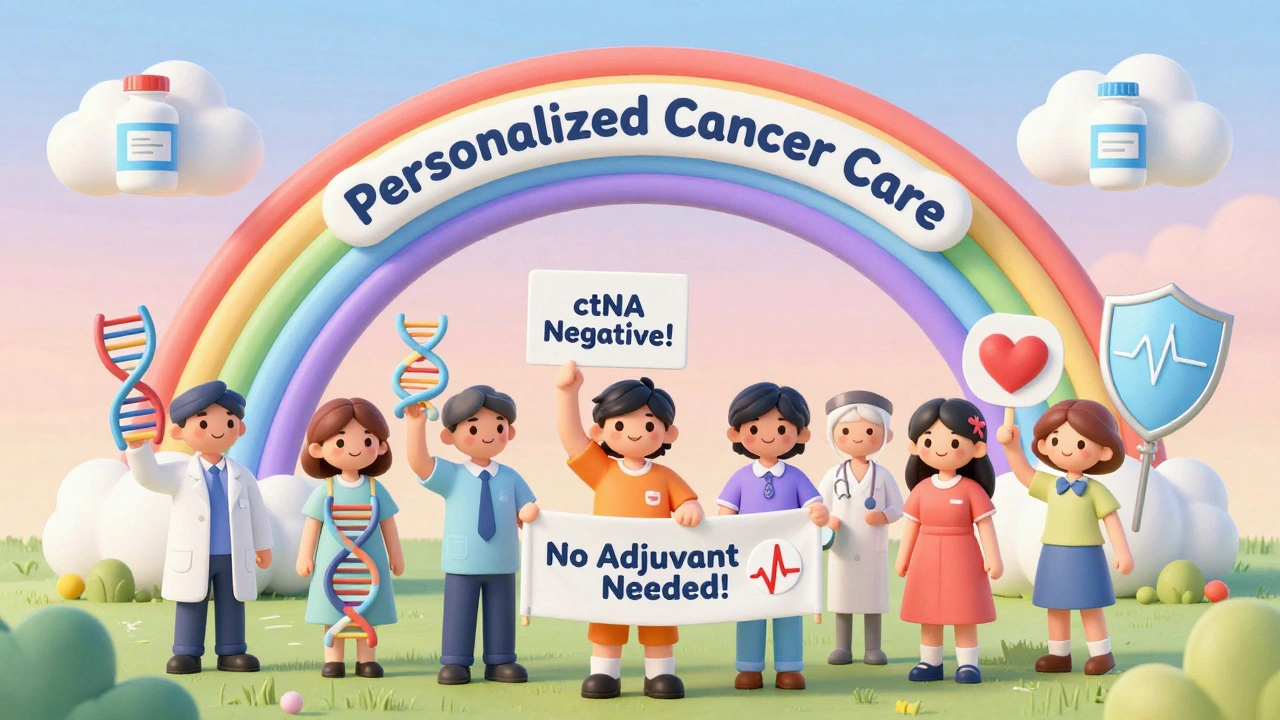
But it’s not one-size-fits-all. Some tumors are sneaky. Even if they shrink, they might still be hiding. That’s why doctors now watch for signs like circulating tumor DNA (ctDNA) after surgery. If cancer DNA is still floating in the blood, that’s a red flag-and that’s when adjuvant therapy might still be needed.

Who Gets Neoadjuvant Therapy? It’s Not Random
Doctors don’t just pick neoadjuvant therapy because it’s trendy. There are clear guidelines.
For NSCLC, the NCCN recommends neoadjuvant chemoimmunotherapy for patients with stage IB (tumor ≥4 cm) through IIIA. That’s when the cancer is large or has spread to nearby lymph nodes-but still operable. If your tumor is small and isolated, you’re more likely to go straight to surgery.
In breast cancer, neoadjuvant therapy is standard for:
- Triple-negative breast cancer (TNBC)
- HER2-positive breast cancer
- Large hormone receptor-positive tumors that need downsizing
Why? Because these types respond best to chemo and immunotherapy. And if the tumor shrinks, you might avoid a full mastectomy-maybe just a lumpectomy. That’s huge for body image and recovery.
For hormone receptor-positive breast cancer, the decision is trickier. If the tumor is slow-growing and the patient is older, doctors might skip neoadjuvant therapy entirely. But if the tumor is large and the patient wants breast conservation, neoadjuvant chemo becomes a tool to make surgery easier.
What Happens During the Waiting Period?
Neoadjuvant therapy means you wait. Usually 3 to 4 cycles over 9 to 12 weeks. That’s a long time to sit with uncertainty.
A 2023 survey from the Lung Cancer Alliance found that 62% of NSCLC patients felt anxious about their cancer growing during that window. That’s normal. But here’s the flip side: patients who got neoadjuvant therapy reported feeling more in control. “I knew if the treatment worked, I’d see it,” one patient wrote. “That gave me hope.”
Doctors monitor progress with scans-CTs, PETs, MRIs-using standard criteria like RECIST. If the tumor shrinks by 30% or more, that’s a good sign. If it grows? That’s a signal to switch strategies before surgery.
And timing matters. Surgery usually happens 3 to 6 weeks after the last dose. Too soon, and your body hasn’t recovered. Too late, and you risk resistance or progression.
Real People, Real Choices
One woman in Texas, diagnosed with stage IIIA NSCLC in early 2023, chose neoadjuvant nivolumab and chemo. After three cycles, her tumor had shrunk by 85%. Her surgeon told her, “We can do a wedge resection now instead of removing half your lung.” She’s now 18 months out, cancer-free, and working part-time.
Another woman in Florida, diagnosed with early-stage triple-negative breast cancer, chose adjuvant chemo because she didn’t want to delay surgery. Later, she learned her tumor had a high genetic risk. She wished she’d known the benefits of seeing how her cancer responded to chemo first. “I would’ve chosen differently,” she said.
These stories aren’t rare. They’re becoming the new normal.
Barriers to Getting the Right Treatment
Even though the science is clear, access isn’t equal.
A 2023 study found that only 58% of community hospitals have formal neoadjuvant therapy pathways. At academic centers? 92%. That gap means rural patients, low-income patients, and those without specialist access are still getting outdated care.
Also, not every hospital has the expertise to interpret imaging or pathology correctly. Pathologists need to use standardized systems like the Miller-Payne scale for breast cancer or the American College of Pathologists system for lung cancer. Without that, you can’t accurately measure response.
And then there’s the cost. Neoadjuvant immunotherapy can run $150,000 or more per patient. Insurance approvals can take weeks. Some patients delay treatment just to get paperwork sorted.
The Future: Personalized Sequencing
We’re not done yet. The next wave is precision sequencing.
Trials like NeoADAURA are testing whether EGFR-mutant lung cancer patients benefit from neoadjuvant osimertinib (a targeted drug). Early results suggest yes-tumors shrink fast, and recurrence drops.
And ctDNA testing? It’s becoming a game-changer. After surgery, if cancer DNA is still detectable in the blood, that’s a sign the cancer is still active-even if scans look clean. That’s when doctors might add adjuvant therapy. If ctDNA is gone? You might skip it entirely.
By 2030, experts predict 70% of early-stage lung cancer patients will get neoadjuvant therapy guided by biomarkers. Adjuvant therapy won’t disappear-it’ll become targeted. Only for those who need it.
That’s the future: less blanket treatment. More smart, personalized sequencing. Less toxicity. More survival.
What Should You Do?
If you or a loved one is facing surgery for lung, breast, or another solid tumor, ask these questions:
- Is neoadjuvant therapy an option for my cancer type and stage?
- What’s the chance of a pathologic complete response with my treatment plan?
- Will we test for PD-L1, BRCA, EGFR, or other biomarkers?
- Will we check ctDNA after surgery?
- Is there a chance we can skip adjuvant therapy if the tumor responds well?
- Can I see a multidisciplinary team before deciding?
Don’t accept “we’ve always done it this way.” The standard changed in 2022. It’s changed again in 2024. You deserve a plan based on today’s best science-not yesterday’s assumptions.
Rebecca M.
December 2, 2025 AT 21:52So let me get this straight-we’re now supposed to be thrilled that chemo before surgery means we get to wait longer and wonder if the tumor’s ‘responding’? Meanwhile, my insurance is still denying the PET scan because it’s ‘not medically necessary’ until after the cut. Thanks, oncology.
Steve World Shopping
December 4, 2025 AT 13:20The paradigm shift from adjuvant to neoadjuvant sequencing represents a fundamental reorientation in systemic oncologic management, predicated on the integration of pathologic complete response (pCR) as a surrogate endpoint for event-free survival (EFS). The CheckMate 816 data, in particular, demonstrates statistically significant improvement in EFS (HR 0.64; 95% CI 0.49–0.83) with neoadjuvant chemoimmunotherapy, validating the biological plausibility of tumor microenvironment modulation prior to resection.
Moreover, the 2024 meta-analysis challenging the necessity of postoperative immunotherapy suggests that the immunologic priming induced by neoadjuvant PD-1 blockade may engender durable T-cell memory, obviating the need for subsequent systemic exposure. This aligns with the ‘in situ vaccination’ hypothesis, wherein tumor antigen release during neoadjuvant therapy enhances dendritic cell cross-presentation.
However, the heterogeneity in pCR rates across molecular subtypes-particularly in ER+/HER2− disease-remains a confounder. Biomarker-driven selection (PD-L1 CPS ≥1, TMB-H, ctDNA clearance) is now non-negotiable for optimal patient stratification.
The accessibility gap between academic centers and community hospitals remains a moral failing of our healthcare infrastructure. We are stratifying outcomes not by biology, but by zip code.
And let’s not forget: pathologic assessment requires standardized criteria-Miller-Payne, Mandard, or CAP guidelines. Without rigorous pathology review, pCR becomes a statistical mirage.
Neoadjuvant therapy isn’t ‘trendy.’ It’s evidence. And if your oncologist hasn’t updated their protocol since 2020, you need a new one.
Lynn Steiner
December 4, 2025 AT 21:09I cried reading about that Texas woman. 85% shrinkage. Wedge resection. 18 months cancer-free. 😭 I just had my second mastectomy last month and they gave me chemo AFTER. I didn’t know I could’ve had a chance to see if it worked first. Now I’m stuck with nerve pain and PTSD and wondering if I missed my shot. Why didn’t anyone tell me? 😭
Alicia Marks
December 4, 2025 AT 23:01You’ve got options. You’ve got science on your side. Ask the questions. Push for the scans. Demand the biomarker testing. You’re not just a patient-you’re the CEO of your own body. And you deserve a plan that fits you, not the one they’ve always done.
Paul Keller
December 5, 2025 AT 18:39While the literature increasingly supports neoadjuvant immunotherapy in select cohorts, it is imperative to acknowledge the limitations of the data presented. The CheckMate 816 trial, while robust, enrolled a highly selected population with favorable performance status and access to tertiary care. Generalizability to older patients, those with comorbidities, or those in resource-limited settings remains unproven. Furthermore, the cost-benefit analysis of neoadjuvant regimens-particularly those involving checkpoint inhibitors-must be contextualized within national healthcare systems. In the U.S., the per-patient expenditure exceeds $150,000, and the incremental survival benefit, while statistically significant, translates to a marginal gain in life expectancy for many subgroups. The ethical imperative to reduce toxicity must be weighed against the potential for overtreatment in low-risk populations. We must not conflate statistical significance with clinical necessity.
Shannara Jenkins
December 6, 2025 AT 05:47My mom had triple-negative breast cancer last year. She did neoadjuvant chemo and got a pCR. She didn’t need any more chemo after surgery. She said the hardest part wasn’t the nausea-it was waiting to see if it would work. But she also said, ‘Knowing I could see it working made me feel like I had some control.’ I wish more people knew that option exists. You’re not just waiting-you’re gathering intel.
Elizabeth Grace
December 6, 2025 AT 20:11Okay but can we talk about how the word ‘adjuvant’ sounds like ‘adjacent’? Like, is it just hanging out nearby? 🤔 I mean, I get it’s science-y, but why not just call it ‘after surgery chemo’? Why does everything have to sound like a Latin incantation? I’m not a doctor, I’m a person trying to survive this.
Steve Enck
December 8, 2025 AT 14:37The entire paradigm hinges on the assumption that pathologic complete response is a valid surrogate endpoint for overall survival. This is a fallacy rooted in reductionist oncology. Tumor burden reduction does not equate to eradication of metastatic clones. The persistence of minimal residual disease, undetectable by histology, is the true driver of recurrence. Furthermore, the emphasis on immunotherapy in neoadjuvant settings ignores the evolutionary pressure it exerts on tumor immunophenotypes, potentially selecting for immune-evasive clones that manifest later as aggressive, treatment-refractory disease. The data are compelling, but they are not conclusive. We are trading short-term response metrics for long-term uncertainty. And we call this progress?
Jay Everett
December 8, 2025 AT 17:24Bro. Imagine your tumor’s like a stubborn weed. Neoadjuvant therapy? That’s pouring herbicide on it BEFORE you yank it out. You see if it’s gonna die, and if it does? Boom-you pull the roots easy. Adjuvant? You yank it out first, then guess if you got all the roots. 🤯 And now we’ve got ctDNA like a blood test that whispers ‘hey, there’s still some ghost cells floating around.’ That’s next-level detective work. We’re not just treating cancer anymore-we’re outsmarting it. 🙌
मनोज कुमार
December 10, 2025 AT 13:47Joel Deang
December 11, 2025 AT 22:49ok so like… neoadjuvant = chemo before the cut? and adjuvant = after? i thought adjuvant was like… a sidekick? 🤭 anyway i had a friend do neoadjuvant for her lung thing and she said the waiting was worse than the chemo but she got to keep her whole lung instead of half so… win? also i think the word ‘pathologic complete response’ sounds like a sci-fi movie title. 🚀
Roger Leiton
December 12, 2025 AT 20:13Just read this whole thing and I’m honestly emotional. 🥹 I’ve been watching my dad go through this and I didn’t even know we had these options. I’m going to print this out and take it to his next appointment. He’s 72, has stage IIB NSCLC, and they’re talking surgery first. I’m going to ask about neoadjuvant, ctDNA, and whether they test for PD-L1. He deserves to know all of this. Thank you for writing this. 💙
Alicia Marks
December 14, 2025 AT 07:39That’s exactly what I’m talking about. Knowledge is power. And you’re not just fighting cancer-you’re fighting for better care. Keep asking. Keep pushing. You’re doing amazing.