
 Jan, 29 2026
NSAID & Blood Thinner Risk Calculator
Risk Assessment Tool
Select your blood thinner and NSAID to see your increased bleeding risk. This tool uses data from clinical studies to show how combinations affect bleeding risk.
More than 12 million Americans over 65 take blood thinners to prevent strokes or clots. Many of them also suffer from arthritis, back pain, or joint inflammation. It’s no surprise they reach for ibuprofen or naproxen when the pain flares up. But here’s the harsh truth: NSAIDs and blood thinners don’t just mix poorly-they can send you to the emergency room, or worse.
Why This Combination Is So Dangerous
NSAIDs-like ibuprofen, naproxen, and diclofenac-work by blocking enzymes that cause pain and swelling. But they also block another enzyme that helps your blood clot. Meanwhile, blood thinners like warfarin, apixaban, or rivaroxaban prevent clots from forming in the first place. When you take both, your body loses two layers of protection against bleeding. It’s like removing two brakes from a car going downhill. The result? A much higher chance of serious bleeding. A 2024 study in Circulation found that people taking NSAIDs along with blood thinners had more than double the risk of bleeding compared to those on blood thinners alone. Some NSAIDs made things even worse: naproxen raised the risk by 4.1 times, diclofenac by 3.3 times. Even ibuprofen, often thought of as "milder," still increased bleeding risk by nearly 80%.Where the Bleeding Happens
It’s not just one kind of bleeding. This combo hits multiple organs:- Gastrointestinal bleeding: 2.24 times more likely. Stomach ulcers, black tarry stools, vomiting blood-these aren’t rare side effects. They’re common outcomes.
- Intracranial hemorrhage: Over three times more likely. A brain bleed can happen without warning, especially in older adults.
- Urinary tract bleeding: 1.57 times higher risk. Blood in urine isn’t always a sign of infection-it can be from medication.
- Pulmonary bleeding: Less common but still dangerous. Coughing up blood is a medical emergency.
And it’s not just bleeding. These patients are also 2.8 times more likely to develop anemia from chronic blood loss. Fatigue, dizziness, shortness of breath-symptoms many dismiss as "just getting older"-are often signs of slow, silent bleeding.
Not All Blood Thinners Are the Same
The risk isn’t the same across all anticoagulants. Warfarin, the older drug, has the highest bleeding risk when mixed with NSAIDs-up to 3.8 times higher. Newer drugs like apixaban and rivaroxaban are safer overall, but they’re still not safe with NSAIDs.Here’s what the data shows:
| Anticoagulant | Increased Bleeding Risk (HR) | 95% Confidence Interval |
|---|---|---|
| Warfarin | 3.8 | 3.2-4.5 |
| Dabigatran | 2.3 | 1.9-2.8 |
| Rivaroxaban | 2.1 | 1.8-2.4 |
| Edoxaban | 2.0 | 1.7-2.4 |
| Apixaban | 1.9 | 1.6-2.3 |
Even the "safer" options aren’t safe with NSAIDs. The difference isn’t big enough to justify taking the risk.
What About Celecoxib? Is It Safer?
Celecoxib is a COX-2 inhibitor, marketed as gentler on the stomach. It does carry a lower risk of GI bleeding than naproxen or diclofenac-but it’s still not safe. Studies show it still increases bleeding risk by 1.4 times when taken with anticoagulants. And it doesn’t help with platelet function-the main reason NSAIDs are dangerous with blood thinners. So no, it’s not a loophole.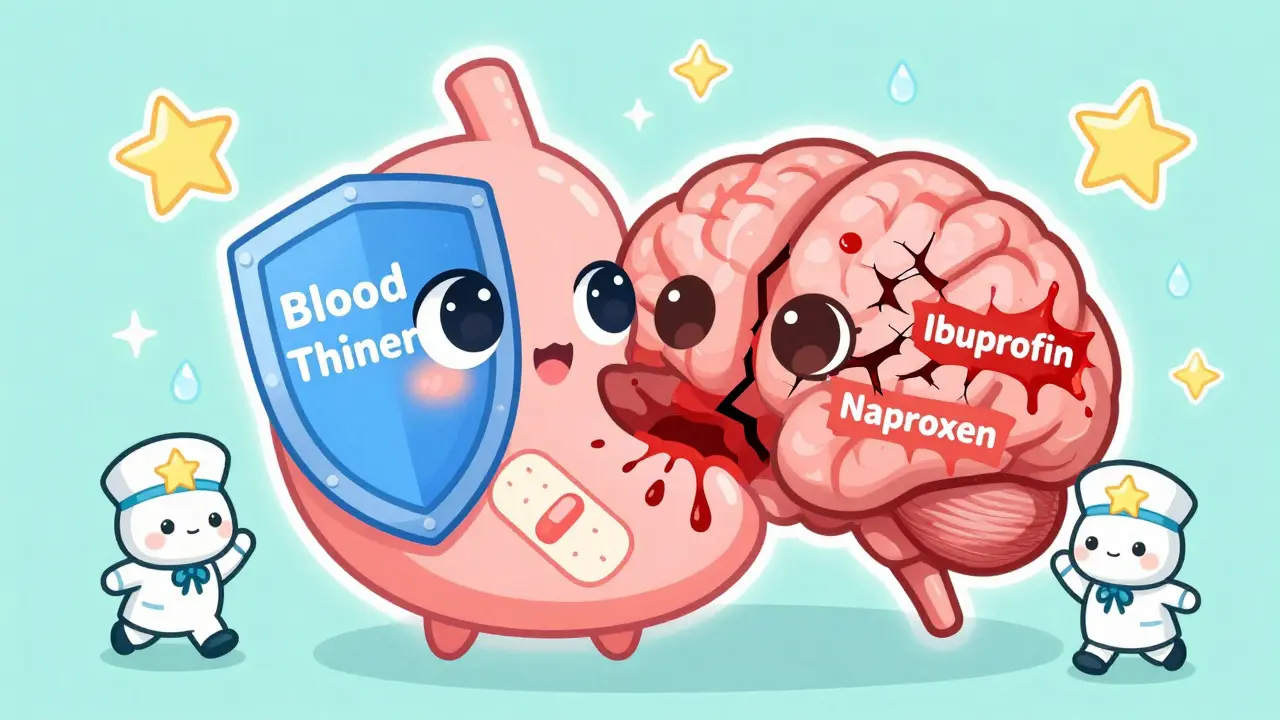
The Only Safe Painkiller: Acetaminophen
There’s one pain reliever that doesn’t interfere with blood thinners: acetaminophen (Tylenol). At doses under 4,000 mg per day, it doesn’t affect clotting or stomach lining. It’s the only recommended alternative for people on anticoagulants.But it’s not perfect. High doses can damage the liver, especially in people who drink alcohol, have fatty liver disease, or take other medications that stress the liver. Still, for most people, it’s the best option.
A 2023 Cleveland Clinic study found that 68% of patients on blood thinners who switched from NSAIDs to acetaminophen had good pain control after four weeks. Many also reported better sleep and more mobility-not because the pain vanished, but because they weren’t afraid of bleeding every time they took a pill.
What Patients Are Actually Doing
Despite warnings, many people keep using NSAIDs. On Reddit’s r/Anticoagulants, 62% of 1,457 respondents admitted to taking ibuprofen or naproxen with their blood thinner. Nearly 40% had experienced bleeding complications-nosebleeds, bruising, or worse.Why? Two big reasons:
- They didn’t know. Nearly half of patients surveyed didn’t realize NSAIDs were dangerous with blood thinners.
- The pain was worse than the risk. People with chronic arthritis feel trapped. They’d rather risk bleeding than live in constant pain.
And it’s not just OTC pills. Many patients get NSAIDs from dentists after extractions, or from physical therapists for muscle pain. One patient in Texas ended up in the ER after taking 800 mg of ibuprofen for a toothache while on apixaban. He bled for 12 hours. His dentist didn’t ask about his blood thinner.
What Doctors Should Do
The American Heart Association, American College of Cardiology, and European Society of Cardiology all agree: avoid NSAIDs in patients on anticoagulants. But in practice, it’s messy.Only 41% of primary care doctors consistently recommend acetaminophen over NSAIDs. Just 22% refer patients to physical therapy, even though it’s proven to reduce joint pain without drugs.
Here’s what works:
- Don’t prescribe NSAIDs at all. Start with acetaminophen and physical therapy.
- If you must use an NSAID: Use the lowest dose possible (ibuprofen ≤400 mg/day), for no more than three days, and always pair it with a proton pump inhibitor like pantoprazole (80 mg daily) to protect the stomach.
- Monitor closely. If the patient is on warfarin, check INR weekly during NSAID use-it can spike by 0.8 to 1.2 points.
And don’t assume patients remember the warning. A 2023 JAMA study found only 29% recalled being told about NSAID risks three months after their doctor’s visit.
Why the System Is Failing
This isn’t just about patient ignorance. The system is broken:- Only 38% of U.S. hospitals have electronic alerts that block prescriptions combining NSAIDs and blood thinners.
- 72% of NSAIDs are bought over the counter without consulting a doctor or pharmacist.
- Patients take an average of 7.3 medications. NSAIDs get lost in the pile.
The cost? Over $1.2 billion a year in U.S. emergency visits and hospitalizations. More than 87,000 ER trips and 24,000 hospital stays each year-all preventable.
What’s Changing
There’s hope. The FDA is pushing for AI tools that flag dangerous combinations before prescriptions are filled. Early tests show 85% accuracy. The 2025 American Heart Association guidelines will likely tighten warnings even further, based on new data showing NSAIDs increase death risk by 1.8 times in anticoagulated patients.Some hospitals are running antithrombotic stewardship programs-dedicated teams that review every anticoagulant prescription. Those programs have cut inappropriate NSAID use by 37%.
And researchers are testing new NSAID formulations that don’t affect platelets. They’re still years away, but they’re coming.
What You Should Do Right Now
If you’re on a blood thinner:- Check every medicine you take-cold pills, muscle rubs, menstrual pain relievers. Many contain NSAIDs.
- Switch to acetaminophen for pain. Stick to 3,000-4,000 mg per day max.
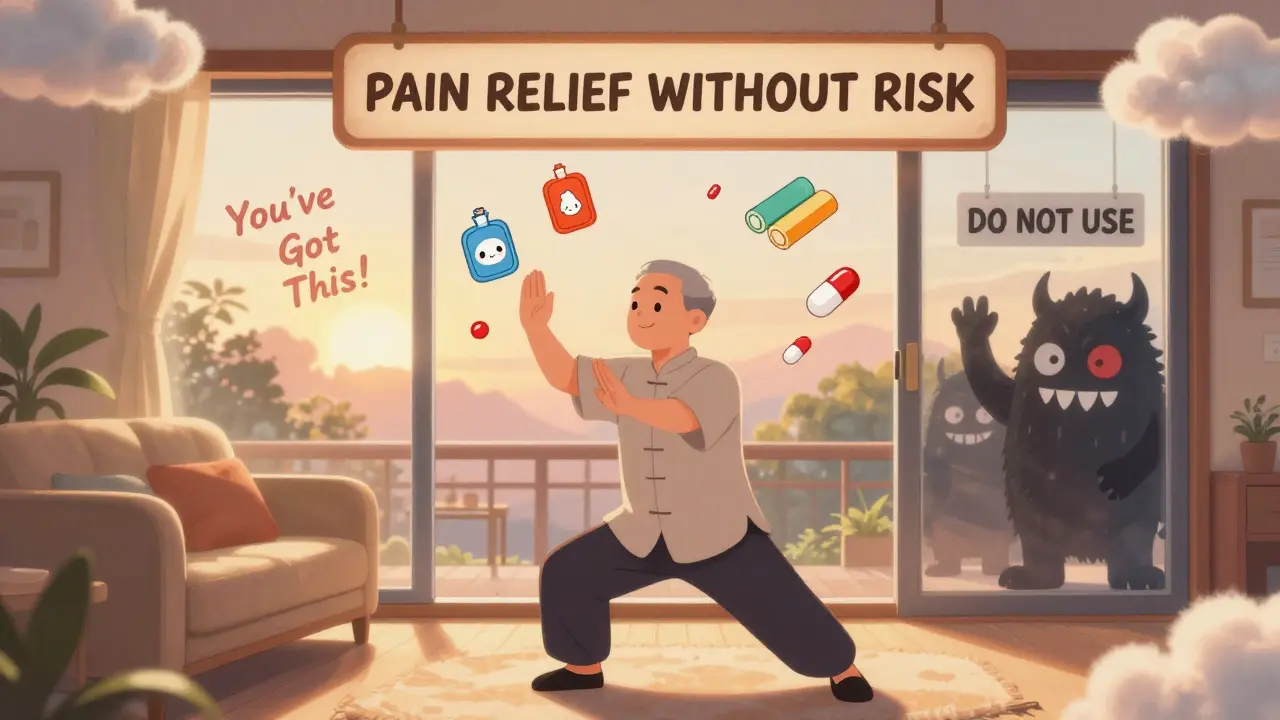
- Ask your doctor about physical therapy, heat therapy, or massage for chronic pain.
- Never take an NSAID without telling your doctor or pharmacist you’re on a blood thinner.
- Carry a list of your medications. If you go to the ER, show it.
If you’re a caregiver for an older adult:
- Check their medicine cabinet. Look for ibuprofen, naproxen, diclofenac-even in "natural" pain creams.
- Help them schedule a med review with their pharmacist. Many pharmacies offer free consultations.
- Don’t assume "it’s just a little pain." Chronic pain is treatable without NSAIDs.
Final Thought
Pain matters. But bleeding matters more. You can manage arthritis without risking a stroke or internal bleed. The tools are there: acetaminophen, physical therapy, lifestyle changes. The problem isn’t lack of options-it’s lack of awareness.Stop thinking of NSAIDs as harmless. For someone on a blood thinner, they’re not. They’re a ticking clock.
Can I take ibuprofen if I’m on warfarin?
No. Taking ibuprofen with warfarin significantly increases your risk of serious bleeding, especially in the stomach and brain. Warfarin already requires careful monitoring, and ibuprofen can raise your INR by 0.8 to 1.2 points, making you much more likely to bleed. Use acetaminophen instead, and only use ibuprofen if absolutely necessary and under direct medical supervision for no more than 2-3 days.
Is Tylenol safe with blood thinners?
Yes, acetaminophen (Tylenol) is the safest over-the-counter pain reliever for people on blood thinners. It doesn’t affect platelets or the stomach lining like NSAIDs do. Stick to 3,000-4,000 mg per day, and avoid alcohol to reduce liver strain. It’s not perfect, but it’s the best option available.
What if I accidentally took ibuprofen with my blood thinner?
If you took one or two doses of ibuprofen and have no symptoms (like unusual bruising, dark stools, dizziness, or blood in urine), you’re likely okay. But stop taking NSAIDs immediately. Contact your doctor or pharmacist. If you’re on warfarin, you may need an INR check sooner than scheduled. If you have any signs of bleeding-vomiting blood, severe headache, weakness, or chest pain-go to the ER right away.
Do all NSAIDs carry the same risk?
No. Naproxen and diclofenac carry the highest bleeding risk-up to 4 times higher when combined with blood thinners. Ibuprofen is lower but still dangerous (1.8x risk). Celecoxib is slightly safer for the stomach but still increases bleeding overall. No NSAID is truly safe with anticoagulants. Acetaminophen is the only recommended alternative.
Can I take aspirin with my blood thinner?
Aspirin is an NSAID and a blood thinner itself. Combining it with another anticoagulant (like warfarin or apixaban) greatly increases bleeding risk. Unless your doctor specifically prescribed low-dose aspirin for heart protection, don’t take it with your blood thinner. Many people assume aspirin is "different," but it’s one of the most dangerous combinations.
How can I manage arthritis pain without NSAIDs?
Try acetaminophen first. Then add non-drug options: physical therapy, heat packs, low-impact exercise like swimming or tai chi, weight loss if needed, and topical capsaicin creams. Some patients benefit from corticosteroid injections or braces. Ask your doctor about a referral to a pain specialist or rheumatologist. Many people find their pain improves significantly without NSAIDs once they find the right combination of alternatives.
Why don’t pharmacists warn me when I buy NSAIDs?
Most pharmacies don’t automatically screen for drug interactions unless you’re picking up a prescription. Over-the-counter NSAIDs are sold without checks, even though they’re dangerous with anticoagulants. Always tell the pharmacist you’re on a blood thinner before buying any pain reliever. Many now have warning stickers on NSAID shelves, but you still need to ask.
owori patrick
January 30, 2026 AT 03:44Man, this hit home. My uncle was on warfarin and kept popping ibuprofen for his knees. One day he passed out from a GI bleed. No warning, no nothing. They didn’t even know he was taking it. We’re lucky he made it.
Everyone needs to hear this. Not just the elderly-caregivers, pharmacists, even dentists. I’m sharing this with my whole family.
Claire Wiltshire
January 30, 2026 AT 13:08This is an exceptionally well-researched and vital piece of public health information. The data presented-particularly the hazard ratios for each anticoagulant class-is both alarming and actionable.
It’s deeply concerning that over-the-counter NSAIDs are sold without mandatory interaction warnings, especially given that 72% of users obtain them without clinician consultation. The systemic failure here is not merely logistical-it’s ethical. Pharmacists must be empowered (and required) to screen for anticoagulant use at point of sale. And electronic health records need mandatory, non-skippable alerts. Lives depend on it.
Darren Gormley
January 31, 2026 AT 11:23Bro, this is just fearmongering 😅
I take naproxen with rivaroxaban every day and I’m fine. My INR’s been stable for 3 years. You guys are acting like NSAIDs are cyanide. Chill. Also, acetaminophen kills your liver faster than a whiskey shot. 🤷♂️
Maybe stop treating people like toddlers and let them decide their own risk?
Mike Rose
February 1, 2026 AT 14:22so like... tylenol is good? cool. but like, why do they even make ibuprofen if it’s so bad? 🤨
also my grandma takes it for her back and she’s 82. still walking. so idk man.
Russ Kelemen
February 3, 2026 AT 00:12This isn’t just about medication-it’s about how we treat aging, pain, and autonomy.
We’ve created a system where chronic pain is treated like a problem to be numbed, not a signal to be understood. We hand out NSAIDs like candy because it’s faster than physical therapy, cheaper than specialists, and easier than listening.
But the real tragedy? People aren’t choosing bleeding over pain. They’re choosing pain over helplessness. We need to give them better options-not just a different pill.
Acetaminophen isn’t the end goal. It’s the first step toward dignity.
Let’s stop asking people to pick between pain and death. Let’s build systems that let them have neither.
Diksha Srivastava
February 4, 2026 AT 09:58You guys are amazing for sharing this!! 🙌
I’m so glad I read this before my dad started taking naproxen for his arthritis. We switched to Tylenol and started daily walks-his pain is actually better now! No more scary bruising either.
Keep spreading this knowledge. One post can save a life. 💛
Sidhanth SY
February 6, 2026 AT 04:34Real talk: I’ve seen this happen in my village back home. Elderly folks take NSAIDs because they’re cheap and available. No doctor, no pharmacy, just the local shop. They don’t even know what a blood thinner is.
Education needs to be grassroots. Not just hospital pamphlets-community radio, temple announcements, WhatsApp groups. This info should be in dialects, not just English.
And yeah, acetaminophen works. We’ve tested it.
Adarsh Uttral
February 8, 2026 AT 00:07so like... i took ibuprofen last week and im on xarelto. nothin happened. so maybe its not that bad? 🤔
also why dont they just make a new pill that does both? like a painkiller that dont bleed you out?
April Allen
February 8, 2026 AT 06:20From a pharmacokinetic standpoint, the interaction is not merely additive-it’s synergistic. NSAIDs inhibit COX-1-mediated thromboxane A2 synthesis, which impairs platelet aggregation, while anticoagulants target the coagulation cascade downstream. The convergence of these mechanisms creates a pharmacodynamic double-hit that significantly lowers the hemostatic threshold.
Additionally, the GI mucosal vulnerability is amplified by reduced prostaglandin E2, which normally maintains gastric mucosal perfusion and mucus secretion. This is why PPI co-administration is recommended even in low-dose NSAID regimens-though it doesn’t mitigate platelet dysfunction.
Acetaminophen remains the only non-interacting analgesic, but its hepatic metabolism via CYP2E1 and glucuronidation pathways necessitates caution in patients with polypharmacy or hepatic insufficiency.
Sheila Garfield
February 8, 2026 AT 20:32I’m so glad this got posted. My mom was on Eliquis and took ibuprofen for her shoulder for months. She didn’t even think to tell her doctor. She got a nosebleed that wouldn’t stop one night-we rushed her in.
They didn’t even ask about OTC meds. Just assumed it was allergies.
Now I keep a list of meds in my wallet. And I check every bottle. Even the ‘natural’ pain creams. So many have menthol and camphor… and some even have NSAIDs hidden in the ingredients.
Just… please, talk to your people.
Shawn Peck
February 10, 2026 AT 03:21THIS IS A MASSIVE COVER-UP. BIG PHARMA doesn’t want you to know this. Why? Because Tylenol is cheap. NSAIDs? They’re profitable. They’ve been pushing this for decades. Dentists? They’re paid to give out ibuprofen. Pharmacists? They don’t care. Your doctor? They’re rushed.
YOU’RE BEING POISONED. AND NO ONE WILL TELL YOU.
SHARE THIS. NOW. BEFORE IT’S TOO LATE.
Sarah Blevins
February 11, 2026 AT 09:50While the data presented is statistically significant, the clinical relevance of the hazard ratios remains context-dependent. The absolute risk increase for major bleeding in a low-risk population on DOACs may be less than 1% per year. Overgeneralizing this to all patients may lead to undertreatment of pain, reduced quality of life, and increased opioid utilization.
Additionally, the cited 2024 Circulation study did not control for NSAID dosage duration or frequency, which are critical confounders. A single 400mg dose of ibuprofen carries negligible risk compared to chronic daily use.
Recommendations should be stratified-not absolute.
Shubham Dixit
February 13, 2026 AT 08:07Look, I don't care what some American study says. In India, we've been mixing ibuprofen with blood thinners for 30 years. My uncle, my aunt, my cousin-they all live. No one dies from this. You people are too scared of your own shadows. You take one pill and you think the world is ending. We have real problems here-starvation, corruption, no hospitals. You think your little bleeding risk matters? You're so privileged you can afford to be paranoid.
And acetaminophen? It's poison. It's made in China. You think that's safe? You trust Western medicine? You're fools.
Stick to turmeric. That's real medicine. Not your fancy pills.