
 Jan, 4 2026

Imagine your body suddenly flooding with adrenaline-no warning, no trigger-just a pounding heart, drenching sweat, and a headache so severe it feels like your skull is splitting. Your blood pressure spikes to 240/130. You think it’s a panic attack. Maybe you’ve been told you’re just stressed. But what if it’s not anxiety? What if it’s a tiny, hidden tumor in your adrenal gland, silently dumping adrenaline into your bloodstream? That’s pheochromocytoma.
What Exactly Is a Pheochromocytoma?
Pheochromocytoma is a rare tumor that grows in the adrenal medulla, the inner part of the adrenal glands sitting on top of your kidneys. These glands normally make hormones like adrenaline and noradrenaline when you’re scared, excited, or under stress. But a pheochromocytoma doesn’t know when to stop. It pumps out massive amounts of these hormones, even when you’re lying still on the couch.
This isn’t just high blood pressure. It’s episodic, unpredictable, and dangerous. One minute you’re fine. The next, you’re trembling, pale, and barely able to breathe. These episodes-called “spells”-can be triggered by anything: lifting a heavy box, emotional stress, even going to the bathroom. In rare cases, tumors in the bladder (called paragangliomas) cause spells during urination.
Doctors see this tumor in about 1 in every 200 people with high blood pressure. That sounds rare, but because high blood pressure affects nearly half of U.S. adults, that still means thousands of undiagnosed cases every year. And here’s the kicker: 90% of these tumors are benign. But even if they’re not cancerous, they can still kill you if left untreated.
The Classic Triad: Headache, Sweating, Palpitations
If you’ve got pheochromocytoma, you’re likely experiencing the classic trio:
- Severe headaches (85-90% of cases)
- Profuse sweating (75-80%), often soaking through clothes
- Heart palpitations or racing pulse (70-75%)
These aren’t mild symptoms. These are life-altering. People describe it as feeling like they’re having a heart attack-or worse, like their body is being hijacked. Some also get nausea, abdominal pain, weight loss, or feel like they’re having panic attacks. But unlike true anxiety disorders, these episodes come with wildly elevated blood pressure-sometimes over 180 mmHg systolic.
And here’s something most doctors miss: about 10% of patients also get orthostatic hypotension-meaning their blood pressure crashes when they stand up. That’s because the tumor messes with your body’s ability to regulate blood pressure normally. So you’re bouncing between spikes and crashes. No wonder people end up in emergency rooms thinking they’re having a nervous breakdown.
Why Diagnosis Takes Years (And How to Get It Right)
On average, people wait 3.2 years before getting the right diagnosis. Why? Because most doctors see one or two cases in their entire career. Primary care physicians are trained to think of common causes first-stress, anxiety, migraines, even menopause. And honestly, the symptoms overlap too much.
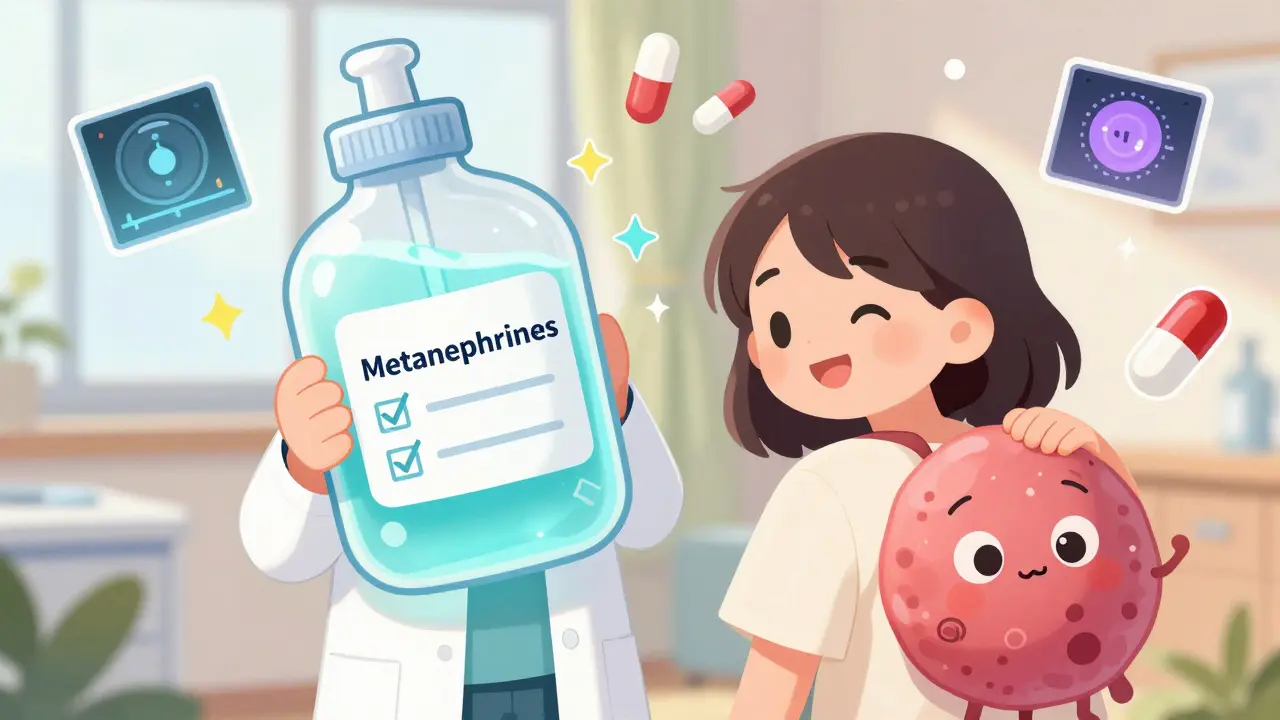
But there’s a test that doesn’t lie: 24-hour urinary fractionated metanephrines. This measures the breakdown products of adrenaline and noradrenaline in your urine. It’s 96-99% sensitive. If it’s positive, you have a pheochromocytoma until proven otherwise.
Plasma-free metanephrines are also used-just as accurate. But here’s the catch: if your levels are only slightly elevated, don’t jump to conclusions. About 15-20% of borderline results turn out to be false positives. Stress, certain medications (like antidepressants or decongestants), or even caffeine can bump up the numbers. That’s why doctors need to rule out those triggers first.
Imaging comes next-CT or MRI-to find the tumor. But here’s the twist: 10% of these tumors aren’t even in the adrenal glands. They’re elsewhere in the abdomen or chest. Those are called paragangliomas. And 10% are bilateral-meaning both adrenal glands are affected. That changes everything.
Genetics Matter More Than You Think
One of the biggest shifts in recent years? We now know that 35-40% of pheochromocytomas are hereditary. That means if you have one, your siblings, children, or parents might be at risk too.
Genes like SDHB, SDHD, VHL, RET, and NF1 are commonly involved. Some of these mutations carry a higher risk of cancer. For example, people with SDHB mutations have a 30-50% lifetime chance of developing malignant pheochromocytoma. That’s why genetic testing is now recommended for every single patient, no matter their family history.
One study found that 25% of people who thought they had a “sporadic” tumor actually had a hidden genetic mutation. That’s why skipping genetic testing is no longer an option. It’s not just about you-it’s about your whole family.
Surgery: The Only Cure
This is the most important part: pheochromocytoma is curable with surgery. In 85-90% of cases, removing the tumor completely normalizes blood pressure. Patients who were on three or four blood pressure meds for years walk out of the hospital off all of them.
But here’s the catch: you can’t just operate. If you do, you risk a catastrophic hypertensive crisis during surgery-blood pressure soaring so high it can cause stroke, heart attack, or death. That’s why preoperative preparation is non-negotiable.
At least 7-14 days before surgery, patients start alpha-blockers like phenoxybenzamine. These drugs block the effects of adrenaline on blood vessels, preventing dangerous spikes. You also need to drink 2-3 liters of water a day and eat a high-sodium diet. Why? Because chronic adrenaline exposure shrinks your blood volume by 20-30%. You’re dehydrated in a way your body doesn’t even realize. Replenishing fluids prevents collapse during tumor removal.
The surgery itself is usually done laparoscopically-small incisions, quick recovery. Most people go home in 1-2 days. But if the tumor is large, stuck to major blood vessels, or there’s bleeding, surgeons may need to switch to open surgery. That happens in 5-8% of cases.
What Happens After Surgery?
For most people, recovery is smooth. Blood pressure normalizes within hours. Symptoms vanish. Many report feeling like they’ve been given a second life.
But not everyone.
If both adrenal glands are removed-which happens in about 10% of cases-you’ll need lifelong steroid replacement: hydrocortisone and fludrocortisone. Without them, you can go into adrenal crisis-low blood pressure, vomiting, confusion, even coma. One patient on a support forum wrote: “I went from being healthy to needing pills every morning just to survive.”
Even if only one gland is removed, some people feel exhausted for months. About 12% report chronic fatigue lasting over six months. That’s not just physical-it’s emotional. You’ve been fighting this for years. Your body is still catching up.
What About Cancer?
Only about 10% of pheochromocytomas are malignant. But here’s the problem: we don’t know for sure if a tumor is cancerous until it spreads. There’s no clear cell marker. So if you have a large tumor, SDHB mutation, or symptoms that return after surgery, you’ll need lifelong monitoring.
For metastatic cases, treatments are improving. PRRT (peptide receptor radionuclide therapy) uses radioactive molecules to target tumor cells. Early results show a 65% response rate. New drugs like Belzutifan, originally for kidney cancer, are now being tested in VHL-related pheochromocytomas. And advanced imaging like 68Ga-DOTATATE PET/CT finds tiny tumors that old scans miss.
Still, the prognosis drops sharply if it spreads. Five-year survival for metastatic disease is only 50%. That’s why early detection saves lives.
What You Should Do If You Suspect This
If you’ve had unexplained spells of sweating, pounding heart, and headaches-especially with high blood pressure-ask your doctor for a 24-hour metanephrine test. Don’t wait. Don’t assume it’s stress. Don’t let another doctor tell you it’s anxiety.
Bring this information with you. Print out the classic triad. Mention the possibility of pheochromocytoma. Most doctors won’t think of it-but if you’re persistent, you might save your life.
And if you’re diagnosed? Get genetic testing. Talk to an endocrine surgeon. Don’t rush into surgery without proper prep. And join a support group. There are over 12,500 people on Facebook who’ve been where you are. They know what you’re going through.
Pheochromocytoma is rare. But it’s not mysterious. It’s diagnosable. It’s treatable. And for most people, it’s curable.
Susan Arlene
January 5, 2026 AT 22:27Vinayak Naik
January 6, 2026 AT 07:54Mukesh Pareek
January 8, 2026 AT 03:42Joann Absi
January 9, 2026 AT 18:38Ashley S
January 10, 2026 AT 22:02Rachel Wermager
January 12, 2026 AT 17:58Indra Triawan
January 14, 2026 AT 09:24Leonard Shit
January 14, 2026 AT 17:58Gabrielle Panchev
January 15, 2026 AT 19:49Katelyn Slack
January 15, 2026 AT 22:54Melanie Clark
January 17, 2026 AT 01:26Lily Lilyy
January 17, 2026 AT 17:04Harshit Kansal
January 19, 2026 AT 09:21