
 Feb, 26 2026
Preterm Infant Medication Dosing Calculator
Important Safety Context
Medications for preterm infants require precise dosing adjustments. Only 35% of NICU medications have FDA approval for infants. Dosing errors can cause seizures, organ damage, or death.
WARNING: This tool provides educational guidance only. Actual dosing must be determined by NICU physicians based on comprehensive clinical assessment.
A 10% error in a 800g baby = 80mg overdose. Seizure risk increases by 300% at this error level.
When a baby is born too soon, their body isn’t ready for the world-let alone for the drugs they’re often given to keep them alive. Preterm infants, especially those born before 28 weeks, are exposed to a cocktail of medications in the NICU: opioids for pain, benzodiazepines for sedation, antibiotics for suspected infection, caffeine for apnea, and even acid blockers for reflux. But here’s the hard truth: many of these drugs weren’t designed for babies this small. And the side effects? They don’t just go away after discharge.
Why Preterm Infants Are at Higher Risk
A baby born at 24 weeks isn’t just a tiny version of a full-term infant. Their liver can’t break down drugs the way an adult’s can. Their kidneys barely filter anything. Their gut is still forming. Their brain is growing at lightning speed-and drugs can interfere with that. According to research from the American Academy of Pediatrics, nearly every extremely preterm infant receives at least one medication during their NICU stay. In fact, 42.7% get opioids, and 28.3% get benzodiazepines. These aren’t rare cases. They’re standard practice.But here’s what most people don’t realize: no drug given in the NICU is truly "safe" for preterm infants. Only 35% of medications used in neonatal care have FDA approval for use in babies under one year. The rest? Prescribed off-label, based on guesswork, adult dosing charts, or outdated protocols.
How Medications Behave Differently in Preterm Babies
Drug behavior in preterm infants isn’t just scaled-down adult pharmacology. It’s a completely different system.Take volume of distribution-the space a drug spreads into in the body. In a preterm baby with patent ductus arteriosus (PDA), a common heart condition, this space increases by up to 80%. That means a dose that works perfectly for a baby without PDA might be too low for one with it. Or worse, too high.
Metabolism is even trickier. The liver’s main drug-processing enzymes-cytochrome P450-are only 30% active at 32 weeks’ gestation. They don’t reach adult levels until the baby is a full year old. So a drug that clears quickly in a 3-month-old might build up to toxic levels in a 28-week-old.
And then there’s clearance. A study from the University of Florida found that morphine clearance in preterm infants can vary by over 50% depending on gestational age alone. That’s why two babies of the same weight but different birth weeks need completely different doses.
The Hidden Cost of Common NICU Drugs
Let’s look at the most frequently used medications-and what they really do.- Caffeine citrate (for apnea): Given to over 80% of preterm infants. Sounds harmless? It’s not. About 18.7% develop fast heart rates. 7.3% can’t feed properly because it irritates their gut. Dose adjustments aren’t optional-they’re essential.
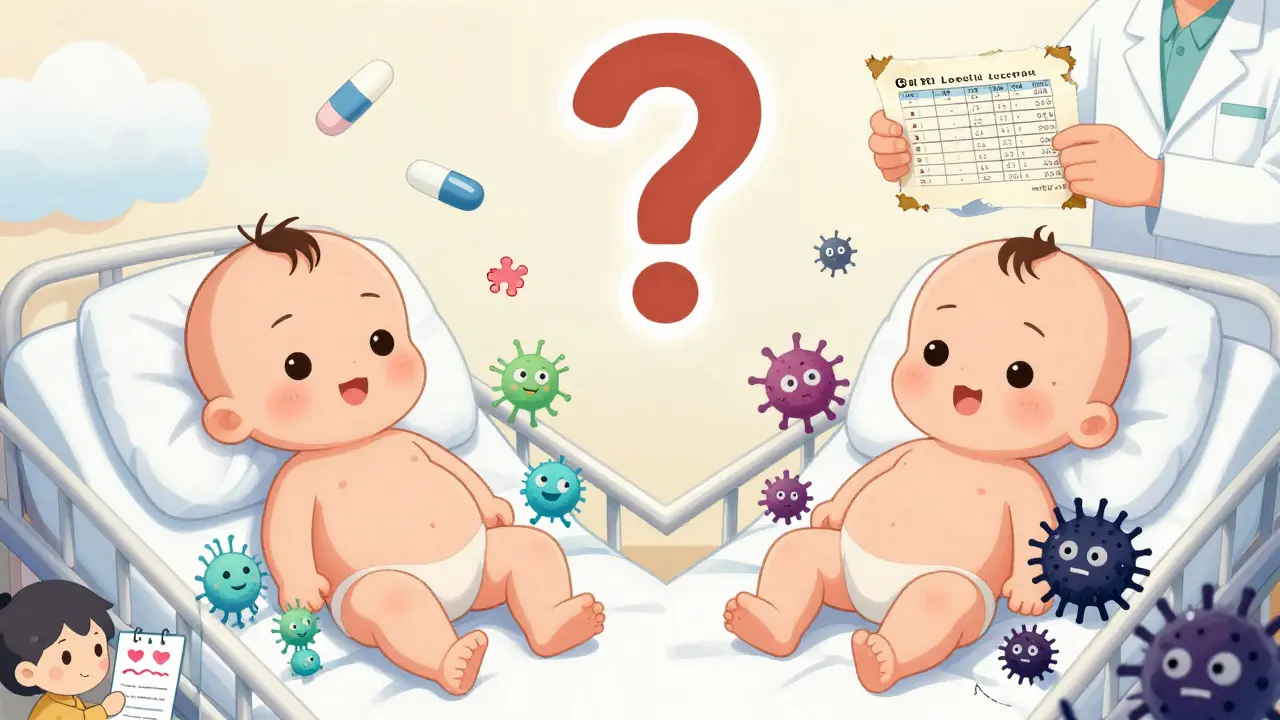
- Antibiotics: Given to nearly half of preterm infants, often as a precaution. But a 2021 study in Nature Microbiology showed these babies end up with 47% more harmful bacteria in their gut, 32% fewer good bacteria like Bifidobacterium, and nearly 3 times more antibiotic-resistant genes. These changes last for years. One parent on Reddit shared: "My son got 28 days of antibiotics for a suspected infection that never showed up. Now at age 2, he’s had five ear infections and two rounds of antibiotics." That’s not coincidence. That’s microbiome damage.
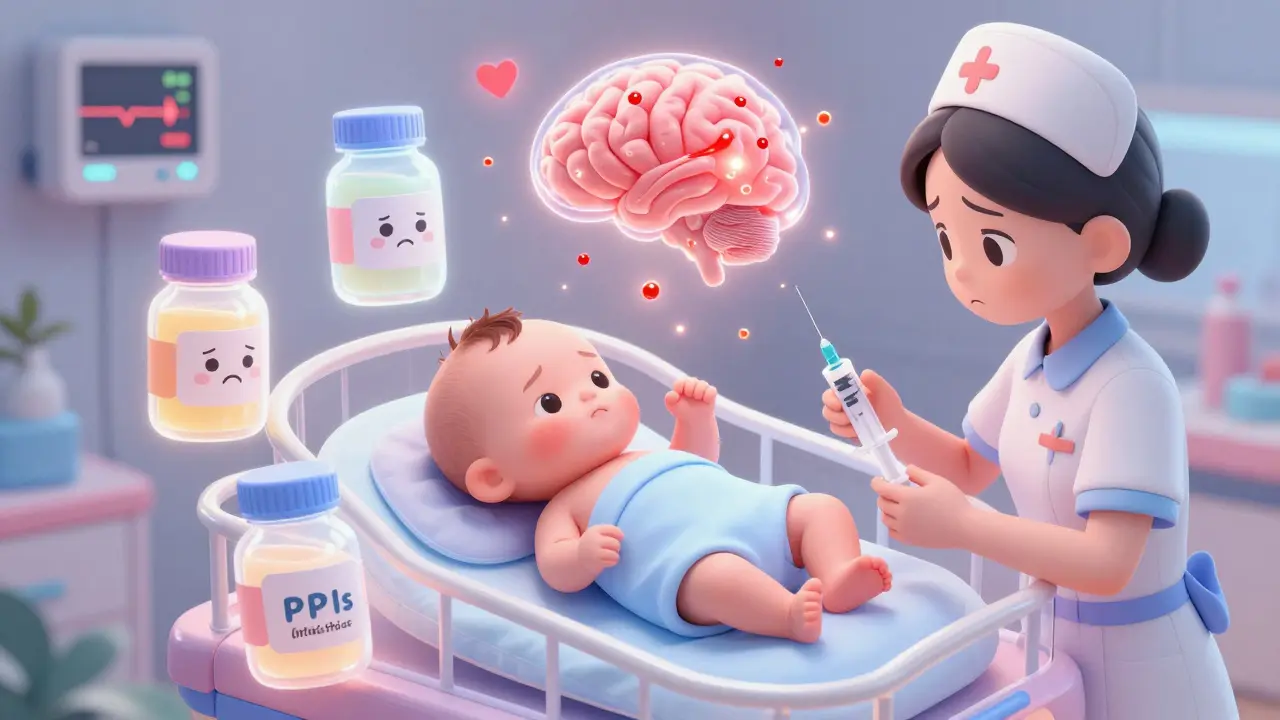
- Proton pump inhibitors (PPIs) (for reflux): Used in 41% of NICU graduates. But here’s the catch: a 2022 Cochrane review found no evidence they help preterm babies with reflux. Yet they increase the risk of necrotizing enterocolitis (NEC) by 1.67 times, late-onset sepsis by 1.89 times, and bone fractures by 2.3 times. Why are they still used? Habit.
- Magnesium sulfate (given to moms before birth): Reduces cerebral palsy risk by 30% in babies under 28 weeks. Sounds great, right? But in babies under 26 weeks, it increases the risk of meconium ileus-a dangerous bowel blockage-by 2.4 times. Every benefit comes with a hidden cost.
Medication Errors Are More Common Than You Think
Nurses in the NICU don’t make mistakes because they’re careless. They do it because the system is broken.A 2022 survey in the American Journal of Perinatology found that 68.4% of NICU nurses reported at least one medication error per month. Most of these were weight-based dosing mistakes. A baby weighing 800 grams? A 10% miscalculation means a 80-milligram overdose. That’s not a typo. That’s a seizure risk.
And it’s not just nurses. Pharmacists say 76.3% of NICU medication protocols need to be adjusted based on gestational age. A dose that works for a 30-weeker might kill a 26-weeker. Yet many hospitals still use the same dosing charts for all preterm infants.
What’s Changing-And What’s Not
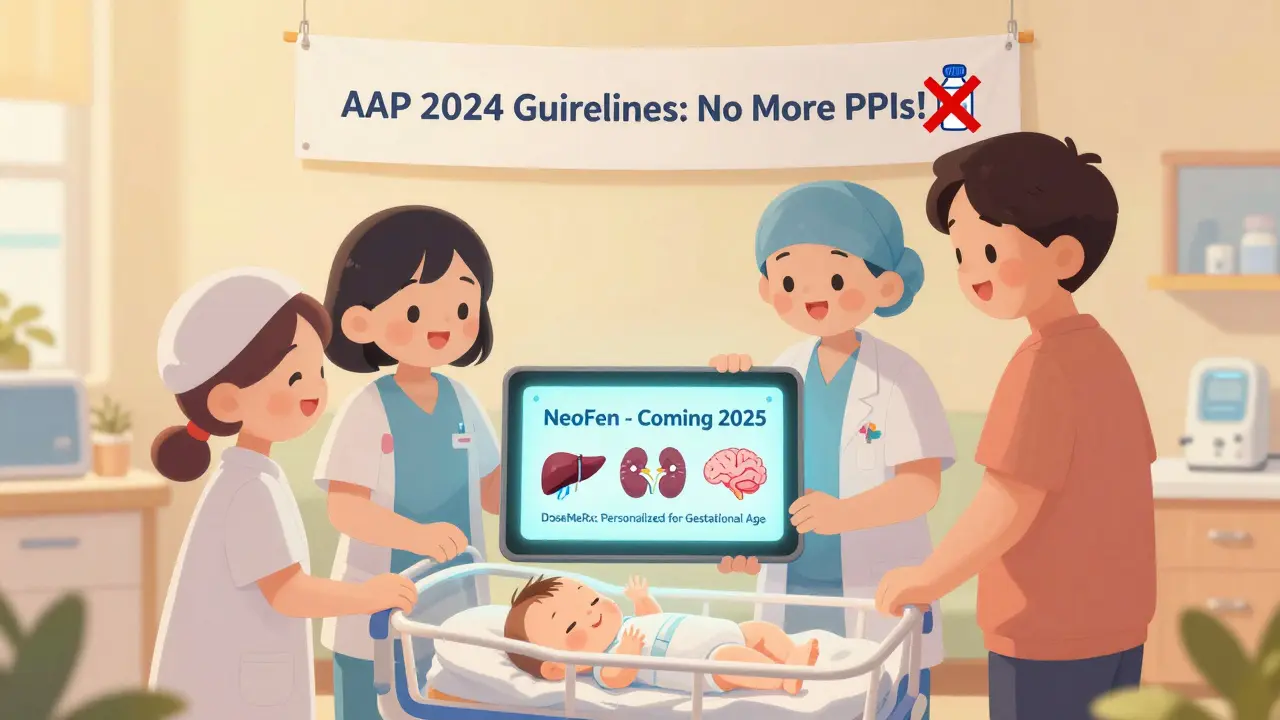
There’s progress. Some NICUs are using software like DoseMeRx to model drug behavior based on gestational age, weight, and organ function. Those that did saw a 58.7% drop in dosing errors. Standardized weaning protocols for opioids and benzodiazepines cut exposure time from 28 days to just 14.4 days-without increasing pain.The AAP updated its guidelines in January 2024 to say: stop giving anti-reflux meds to preterm babies. No benefit. Clear harm. Why did it take so long?
Meanwhile, new tools are on the horizon. The Neonatal Precision Medicine Initiative, launched in 2023, aims to build individualized dosing models for 25 high-risk drugs by 2026. A new version of fentanyl, called NeoFen, is in FDA Fast Track review and could be approved by mid-2025-specifically designed for preterm infants.
What Parents Should Ask
If your baby is in the NICU, you have the right to know what’s being given and why.- "Is this medication FDA-approved for preterm infants?" If not, ask why it’s being used anyway.
- "What are the risks if we don’t give this?" Many drugs are given out of habit, not need.
- "Are we monitoring for side effects?" Ask for specific signs: heart rate, feeding tolerance, stool changes, breathing patterns.
- "Can we reduce or stop this sooner?" Ask about weaning protocols. Don’t assume longer = better.
One parent said it best: "I didn’t know I could question the meds. I thought they knew best. But when I asked, they admitted they were just following the old chart. We changed the plan. My baby improved."
The Bigger Picture
The NICU is a miracle. But it’s also a place where we’re still guessing. We give drugs to save lives-and sometimes, we harm the very babies we’re trying to protect.By 2026, we may have better tools. But until then, the burden falls on clinicians to question routines and on parents to speak up. Because in preterm infants, the smallest dose can have the biggest consequence.
Medication isn’t just a tool in the NICU. It’s a gamble. And the stakes? A child’s brain, their gut, their future.
Are all medications given in the NICU FDA-approved for preterm infants?
No. Only about 35% of medications used in NICUs have FDA approval for use in infants. The rest are prescribed off-label, meaning they’re given based on clinical experience, adult dosing, or small studies-not formal approval. This is especially true for respiratory drugs, antibiotics, and anti-reflux medications, which are used in over 90% of preterm cases despite limited safety data.
Why do preterm infants react differently to drugs than older babies?
Preterm infants have underdeveloped organs that process and eliminate drugs. Their liver enzymes (like cytochrome P450) are only 30% as active as an adult’s at 32 weeks’ gestation. Their kidneys filter slowly, and their body composition-more water, less fat-affects how drugs spread. These factors mean drugs can build up to dangerous levels or clear too quickly, making dosing unpredictable and risky.
Can antibiotics given in the NICU cause long-term health problems?
Yes. Research shows preterm infants exposed to antibiotics develop gut microbiomes with 47% more harmful bacteria, 32% fewer beneficial species like Bifidobacterium, and nearly 3 times more antibiotic-resistant genes. These changes can last for years and are linked to higher rates of infections, allergies, and digestive issues later in childhood. One study found these effects persisted 18 months after discharge.
Is it safe to give reflux medicine like omeprazole to preterm babies?
No. Despite being prescribed to 41% of NICU graduates, studies show acid-suppressing drugs like omeprazole offer no benefit for reflux in preterm infants. Instead, they increase the risk of necrotizing enterocolitis (NEC) by 1.67 times, late-onset sepsis by 1.89 times, and bone fractures by 2.3 times. The AAP updated its 2024 guidelines to recommend against routine use of these drugs in preterm babies.
How can parents help reduce medication risks in the NICU?
Parents can ask three key questions: Is this drug FDA-approved for preterm infants? What are the risks if we don’t give it? Can we monitor for side effects or reduce the dose sooner? Keeping a log of medications, doses, and changes in behavior (feeding, sleep, bowel movements) helps clinicians spot problems early. Don’t be afraid to speak up-medication errors are common, and your input matters.
Brandon Vasquez
February 27, 2026 AT 00:23Just wanted to say I appreciate this post. I had a 26-weeker in the NICU and no one ever explained why we were giving him PPIs. When I asked, they said it was "standard." I pushed back. We stopped it. He started feeding better within days.
Parents aren't just bystanders. We're part of the care team.
Full Scale Webmaster
February 28, 2026 AT 01:54Let’s be real here-this whole NICU medication system is a corporate-run nightmare disguised as medicine. The FDA doesn’t approve drugs for preemies because it’s too expensive to run trials on babies who might die. So pharmaceutical companies just slap "off-label" on everything and let hospitals play Russian roulette with dosing. And don’t get me started on how hospitals get kickbacks from drug manufacturers for using certain brands. It’s not incompetence-it’s profit-driven negligence. We’re literally dosing infants with untested chemicals because it’s cheaper than developing real pediatric formulations. The AAP’s 2024 guidelines? Too little, too late. They’ve been warning about this since the 90s. Meanwhile, the same companies that profit from these drugs are funding the very studies that "prove" they’re safe. It’s a closed loop of corruption. And no one in the media will touch it because Big Pharma owns them too.
Brandie Bradshaw
February 28, 2026 AT 22:58There is no ethical justification for continuing to prescribe proton pump inhibitors to preterm infants-none. The data is overwhelming: no benefit, clear harm. And yet, they’re still given routinely. Why? Because habits override evidence. Because doctors don’t want to admit they’ve been wrong for decades. Because changing protocols requires effort, and effort is inconvenient. This isn’t medical practice-it’s ritual. And rituals are dangerous when they involve vulnerable lives. We need systemic reform, not incremental tweaks. We need mandatory audits of every medication administered, real-time pharmacokinetic modeling, and parental consent for off-label use-not just "discussion." We need to stop pretending that "we’ve always done it this way" is a valid clinical rationale. It’s not. It’s negligence dressed in white coats.
Angel Wolfe
March 1, 2026 AT 17:44Who really controls what goes into these babies? It’s not doctors. It’s not parents. It’s the same people who told us smoking was safe and lead paint was fine. The FDA? They’re just a front. The real power is in the private labs that fund research and the hospital chains that get paid per drug administered. And now they’re pushing this "precision medicine" nonsense like it’s some breakthrough when it’s just a way to charge more. NeoFen? Sounds like a marketing name. Probably just fentanyl with a new label and a 300% markup. They’re not fixing the system-they’re monetizing the crisis. And don’t tell me about "evidence"-I’ve seen the charts. The same hospitals that give 28 days of antibiotics are the ones that get federal grants for "innovation." It’s all a loop. Wake up. This isn’t medicine. It’s a racket.
Ajay Krishna
March 1, 2026 AT 22:20As someone from India who works in neonatal care, I’ve seen both sides-hospitals with outdated protocols and ones that are leading change. The key isn’t just technology, it’s training. When we started using gestational-age-based dosing calculators in our unit, errors dropped by 60% in three months. Parents started asking better questions too. It’s not about blame-it’s about empowerment. We need more global collaboration, not just American-centric solutions. Let’s share data, share tools, share success stories. Preterm babies don’t care about borders. Neither should we.
Charity Hanson
March 2, 2026 AT 20:16Y’all are talking about systems and data-but let’s not forget the human part. My cousin’s baby was in the NICU at 25 weeks. She didn’t know what to ask. She was terrified. But when a nurse sat down with her and said, "Here’s what we’re giving, why, and what we’re watching for," everything changed. Knowledge is power. Not just for doctors. For parents too. I wish someone had told me this sooner. To all the moms and dads reading this: You’re not being nosy. You’re being brave. Keep asking. Keep listening. Your voice matters more than you know.
Ben Estella
March 3, 2026 AT 10:40Anyone who thinks the system is broken is naive. It’s not broken-it’s working exactly as designed. The goal was never to save every preemie. It’s to keep the profit margins high while making parents feel like they’re getting cutting-edge care. The fact that 65% of NICU meds are off-label? That’s not a bug. That’s the business model. And now they’re selling "precision medicine" like it’s magic? Please. The only thing that’s precise is how accurately they’re milking the system. If you want real change, stop trusting institutions. Start organizing. Protest. Boycott. Demand transparency. This isn’t healthcare. It’s exploitation with a stethoscope.
Jimmy Quilty
March 5, 2026 AT 00:57So I read this whole thing and I’m just thinking-what if the real problem is that we’re trying to save babies who shouldn’t even be alive? I mean, 24 weeks? That’s not a baby, that’s a biological accident. We’re throwing billions into keeping these tiny bodies alive while ignoring the real issue: why are so many women delivering this early? It’s stress, poverty, pollution, not some drug protocol. We’re patching symptoms instead of curing causes. And now we’re drugging these fragile kids with untested chemicals just to keep them breathing for a few more weeks? Maybe we should stop pretending science can fix everything. Maybe we need to stop pushing the boundaries of viability and start focusing on prevention. This isn’t progress. It’s overreach.