
 Feb, 21 2026

Statin drugs have saved millions of lives by lowering cholesterol and preventing heart attacks. But for a significant number of people, the benefit comes with a painful trade-off: muscle pain. This isn't just ordinary soreness. It can be persistent, debilitating, and sometimes mistaken for something else entirely. If you're on a statin and suddenly feel like your muscles are constantly achy, weak, or cramping - especially if it started after you began the medication - you're not imagining it. You might be experiencing statin-induced myopathy, a spectrum of muscle problems that range from mild discomfort to a rare but serious autoimmune condition.
What Exactly Is Statin-Induced Muscle Pain?
Statin-induced muscle pain falls under a broad category called statin myopathy. It's not one single problem - it's a range of reactions, from simple discomfort to severe muscle damage. The most common form is myalgia, which means muscle pain without any measurable muscle damage. You feel sore, stiff, or weak, but your blood tests - especially creatine kinase (CK) - stay normal. This affects up to 30% of people taking statins, according to the American College of Cardiology. Many assume it's just aging or overexertion. But if the pain appeared after starting the statin and goes away after stopping it, the link is likely real.
Then there's myositis, a more serious version. This isn't just pain - it's inflammation. Your CK levels rise, often 10 to 40 times above normal. Your muscles are breaking down. You might notice trouble climbing stairs, lifting your arms, or even standing up from a chair. Unlike myalgia, this isn't something you can just "sleep off." It requires medical attention.
At the extreme end is rhabdomyolysis, a medical emergency. This happens when muscle tissue breaks down so badly that it releases proteins into your bloodstream, which can overload your kidneys. CK levels spike over 40 times the upper limit of normal. You might see dark, tea-colored urine. This is rare - affecting only 0.01% to 0.1% of statin users - but it can lead to kidney failure if not treated fast.
The Hidden Culprit: How Statins Damage Muscle
Statins work by blocking an enzyme called HMG-CoA reductase. This cuts cholesterol production in the liver. But here's the catch: that same enzyme is involved in making other vital compounds - not just cholesterol. One of them is coenzyme Q10 (CoQ10), which your muscles need to produce energy. Studies show that taking 40 mg of simvastatin daily can reduce CoQ10 levels in muscle tissue by as much as 40%. That means your muscle cells are running on low battery.
Statins also interfere with something called protein prenylation. This process helps regulate calcium inside muscle cells. When it's disrupted, calcium levels rise abnormally - from the normal 100 nM to 150-200 nM. High calcium triggers enzymes that chew up muscle proteins. Add in exercise, especially eccentric movements like downhill walking or lowering weights, and the damage accelerates. Muscle biopsies show that statins crank up the body's natural waste disposal system - the ubiquitin-proteasome pathway - by 300-400%. Your muscles aren't just tired; they're being actively broken down.
The Rare but Dangerous Form: Immune-Mediated Necrotizing Myopathy
There's another layer to statin muscle pain that most people - even many doctors - don't know about. It's called immune-mediated necrotizing myopathy (IMNM), or statin-associated autoimmune myopathy (SAAM). This isn't a side effect - it's an autoimmune disease triggered by the drug.
Here's how it happens: In some people, statins cause muscle cells to overproduce the very enzyme the drug is meant to block - HMG-CoA reductase. The immune system sees this as a foreign invader and starts attacking it. Antibodies form against HMG-CoA reductase (anti-HMGCR antibodies). These antibodies then go after your own muscle tissue, causing progressive weakness that gets worse over time.
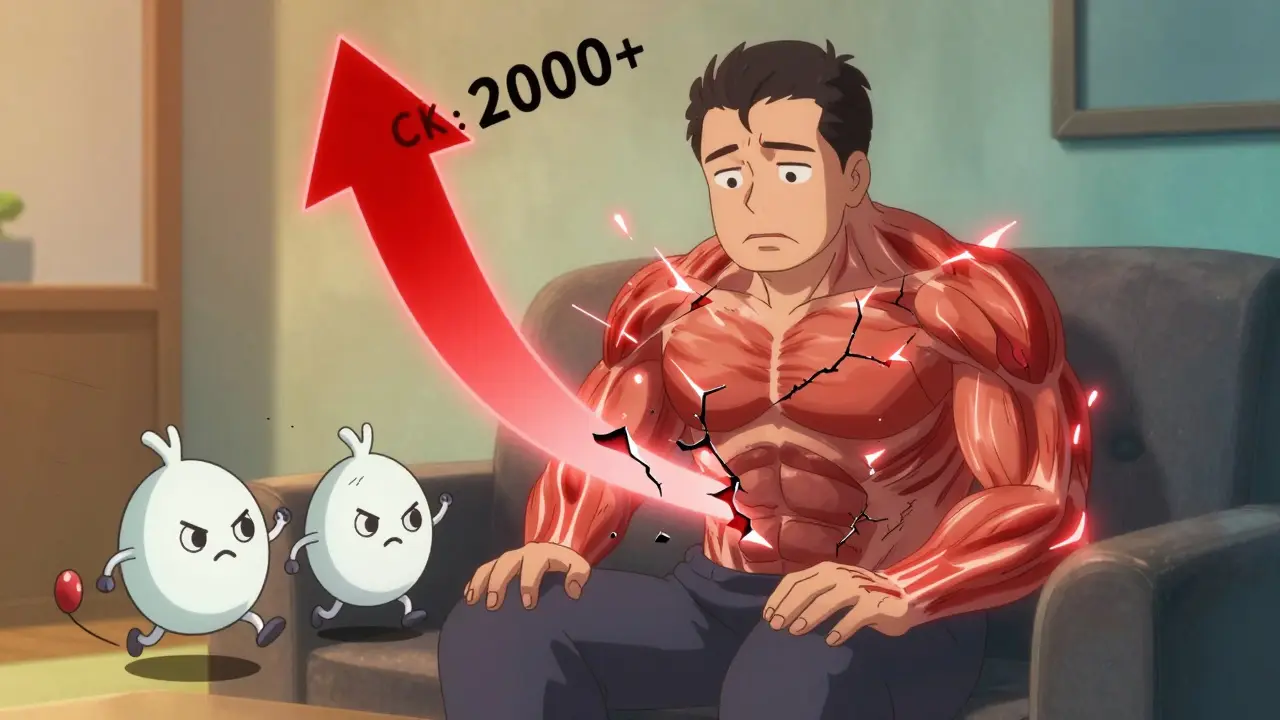
Unlike regular statin myopathy, this doesn't go away when you stop the drug. In fact, symptoms often get worse. About half of patients continue to struggle for 6 to 12 months after quitting statins. Muscle biopsies show dead muscle fibers with almost no inflammation - a telltale sign. CK levels are sky-high, often over 2,000 IU/L (normal is 30-200). This form mostly hits people over 50. Genetics play a role too - 70% of cases have a specific gene variant called HLA-DRB1*11:01.
Diagnosis: It’s Not Just a Blood Test
Many patients are misdiagnosed for months - even years. On forums like Myositis Support and Understanding, 68% of SAAM patients say they were first told they had fibromyalgia or chronic fatigue syndrome. The average delay in diagnosis? Over 11 months.
Here's what real diagnosis looks like:
- Stop the statin. If symptoms improve within 1-2 weeks, it's likely myalgia. If they persist or worsen, dig deeper.
- Check CK levels. Normal? Probably myalgia. Elevated? Could be myositis. Very high? Watch out for rhabdomyolysis or SAAM.
- Test for anti-HMGCR antibodies. This is the key test for autoimmune myopathy. If positive, you're dealing with SAAM.
- Get a muscle biopsy. The gold standard. It shows necrotic fibers with little inflammation - the fingerprint of SAAM.
- Check other causes. Thyroid issues, low vitamin D, and drug interactions (like with amiodarone) can mimic statin myopathy.
Electromyography (EMG) and muscle MRI also help. EMG shows myopathic changes in 80% of confirmed cases. MRI reveals swelling in the hip and shoulder muscles - areas most commonly affected.
Treatment: One Size Doesn’t Fit All
What you do next depends entirely on what you’re dealing with.
For myalgia: Many people can switch to a different statin. Rosuvastatin (Crestor) or pravastatin (Pravachol) are often better tolerated. Dosing changes help too - going from daily to every-other-day dosing works for 40% of patients. Some find relief with CoQ10 supplements (200 mg/day), though studies show mixed results.
For myositis: Stop the statin. Give your body time to heal. Most recover fully in a few weeks. Avoid intense exercise until CK levels normalize.
For SAAM (immune-mediated): This is not a simple case of stopping a drug. You need immunosuppression. Standard treatment is high-dose prednisone (1 mg per kg of body weight daily) plus either methotrexate or mycophenolate. About 60-70% of patients go into remission within a year. If that fails, IVIG (intravenous immunoglobulin) or newer drugs like ravulizumab (a complement inhibitor) are showing promise. Delaying treatment? Big mistake. Patients treated within 6 months of symptoms have a 65% chance of full recovery. If you wait over a year, that drops to 28%.

Who’s at Higher Risk?
Not everyone is equally likely to develop statin muscle problems. Risk factors include:
- Age over 65
- Female sex
- Small body frame
- Chronic kidney disease
- Drug interactions - especially with amiodarone, fibrates, or certain antibiotics
- Genetic variants like SLCO1B1 rs4149056 - this increases simvastatin myopathy risk from 0.6% to 1.4%
- African American descent - studies show 1.8 times higher risk than Caucasians
Interestingly, atorvastatin (Lipitor) shows up in over 43% of statin myopathy reports to the FDA - even though it's prescribed less than half as often as simvastatin. Why? Probably because it's the most widely used statin overall. But the risk is real.
What Happens If You Just Quit?
Stopping statins might fix the muscle pain - but it leaves your heart vulnerable. A 2023 study in Circulation found that people who quit statins due to muscle pain had a 25% higher risk of heart attack or stroke over the next 10 years. That’s huge. You can’t just walk away from cardiovascular protection.
The goal isn’t to avoid statins entirely. It’s to find a version and dose that works for you. For many, switching statins, lowering the dose, or changing the schedule makes all the difference. For others with SAAM, the solution is stronger - immunosuppressants - not avoidance.
The Future: Personalized Statin Therapy
Scientists are moving toward smarter prescribing. A 2024 American Heart Association statement predicts that within five years, we’ll use genetic testing to match patients with the statin safest for their body. Polygenic risk scores could cut myopathy rates by 30-40%. Blood tests for microRNAs (like miR-206 and miR-133a) are already being validated to tell apart autoimmune myopathy from regular muscle pain - with 89% accuracy.
The message is clear: muscle pain on statins isn’t something to ignore. It’s not "just a side effect." It’s a signal. And how you respond to it - whether you stop, switch, or seek specialist care - can make the difference between a healthy heart and a broken muscle.
Bhaskar Anand
February 22, 2026 AT 04:46Statin myopathy? Please. In India, we've been taking cholesterol meds for decades without this drama. You people treat every ache like a medical emergency. If your muscles hurt, maybe you're just out of shape. No need to overcomplicate it with biopsies and antibody tests. Just stop being lazy.
Maranda Najar
February 23, 2026 AT 18:00This article is a revelation. A true masterpiece of medical clarity. I read it with tears in my eyes-not from sadness, but from the sheer, breathtaking beauty of how the author articulated the silent suffering of millions. The way they described HMG-CoA reductase as a traitor within our cells? Poetic. The muscle biopsies? Like poetry written in necrotic fibers. I feel seen. I feel understood. I will carry this knowledge like a sacred flame into the dark nights of my patients' uncertainty.
Christopher Brown
February 25, 2026 AT 01:00Stop the statins? That's not a solution. That's surrender. You're not sick. You're weak. If you can't handle a little muscle discomfort, how are you supposed to handle real life? The system is rigged against the strong. You want to live? Fight.
Sanjaykumar Rabari
February 26, 2026 AT 21:02Statins are a government plot. They put something in the pills to make your muscles hurt so you'll go to the doctor and get more pills. CoQ10? That's a scam. Big Pharma doesn't want you to know that vitamin D and sun exposure cure everything. They want you dependent. Look at the numbers. 40% reduction in CoQ10? That's not science. That's control.
Christina VanOsdol
February 28, 2026 AT 19:32OMG. I just read this and I’m shaking. I’ve been on Lipitor for 8 years and my legs have felt like lead since 2021. I thought I was just aging. I thought I was ‘being dramatic.’ But this? This is it. The anti-HMGCR antibody test? I’m booking it tomorrow. I’ve been misdiagnosed for YEARS. I’m not weak. I’m not lazy. I’m not fibromyalgia. I’m SAAM. And I’m not letting Big Pharma gaslight me anymore. 🙌💔
Brooke Exley
March 2, 2026 AT 02:36You’re not alone. Seriously. If you’re reading this and feeling like your body betrayed you-take a breath. You’re not broken. You’re not failing. You’re a warrior who’s been given bad information. Switching statins? Trying CoQ10? Seeking a specialist? That’s not giving up. That’s upgrading your strategy. You’ve got this. One step. One test. One conversation with your doctor. You’re stronger than you think.
Alfred Noble
March 2, 2026 AT 22:34Hey, I'm not a doc but I've been on Crestor for 6 years and had zero issues until last year. Started lifting again and boom-cramps. Switched to pravachol, cut dose to 10mg, took CoQ10 daily. No more pain. Also, I used to think this was all in my head. Turns out, it's not. Just because you feel it doesn't mean you're crazy. Your body talks. You just gotta learn to listen.
Matthew Brooker
March 4, 2026 AT 17:07This is why we need better education. Most people don’t know the difference between myalgia and SAAM. They panic. They quit. Or they ignore it. Both are dangerous. The real win isn’t avoiding statins-it’s finding the right one. And if you have SAAM? That’s not a failure. It’s a clue. A biological clue. And clues lead to cures. Keep pushing. Keep asking. Keep showing up for your health.
Emily Wolff
March 6, 2026 AT 08:43Myalgia affects 30%? That’s not a side effect. That’s a design flaw. If a drug causes discomfort in one-third of users, it shouldn’t be first-line. The AHA should be embarrassed. And don’t get me started on CoQ10 supplements. Placebo at best. A waste of money. If you need to supplement to fix a drug’s side effect, the drug shouldn’t be prescribed.
Lou Suito
March 6, 2026 AT 18:42Actually, the 30% figure is inflated. Studies show it’s closer to 5-7% when placebo-controlled. And anti-HMGCR? That’s a lab artifact. You can get false positives from infections. The whole SAAM diagnosis is overblown. It’s a money-making scheme for labs and rheumatologists. Stop panicking. Statins are safe. You’re just sensitive.
Joseph Cantu
March 7, 2026 AT 22:58They don’t want you to know this. The pharmaceutical industry, the FDA, the AMA-they all profit from this. Statins are a trillion-dollar industry. Muscle pain? That’s not a side effect. It’s a feature. It keeps you coming back. They don’t care if you’re weak. They care if you’re dependent. They’ll sell you immunosuppressants next. Then biologics. Then IVIG. Then lifelong infusions. This isn’t medicine. It’s a trap.
Jacob Carthy
March 9, 2026 AT 11:43My uncle died of a heart attack after quitting statins because his legs hurt. He thought it was just aging. He was 62. Don’t be stupid. If you’ve got high cholesterol and a family history, you don’t get to pick and choose side effects. You want to live? Take the pill. Find a different one. But don’t quit. That’s how you end up in a coffin before your time.