
 Mar, 14 2026

Most people think of vitamin D as just a bone vitamin. But if you look closer, it’s far more than that. Vitamin D acts like a hormone, talking directly to your endocrine system - the network of glands that control everything from blood sugar to blood pressure. When your vitamin D levels drop, it doesn’t just weaken your bones. It throws off a cascade of signals that affect your thyroid, pancreas, parathyroid, and even your immune cells. And here’s the catch: taking a pill doesn’t always fix the problem. Why? Because what’s in your blood doesn’t always tell you what’s happening inside your tissues.
How Vitamin D Actually Works in Your Body
Vitamin D isn’t a vitamin in the traditional sense. It’s a hormone precursor. Your skin makes it when sunlight hits it - specifically UVB rays between 290 and 315 nanometers. That’s why people in northern latitudes or those who work indoors often have low levels. Once made, it travels to your liver, where it becomes 25-hydroxyvitamin D [25(OH)D]. This is the form doctors measure in blood tests. But here’s where things get tricky: 25(OH)D isn’t active. It needs one more step - a conversion in your kidneys into 1,25-dihydroxyvitamin D [1,25(OH)2D], or calcitriol. That’s the real hormone that binds to receptors in your cells.
These receptors - called VDRs - are found in nearly every tissue: your intestines, bones, kidneys, immune cells, pancreas, and even blood vessels. When calcitriol attaches to a VDR, it turns genes on or off. One study found it regulates over 11,000 genes. About 43% of those affect metabolism. Another 19% control how tissues form and repair. That’s why low vitamin D is linked to more than just osteoporosis. It’s tied to insulin resistance, high blood pressure, and even autoimmune conditions.
The Classic Endocrine Role: Calcium and Bone Health
The clearest job of vitamin D is keeping your blood calcium in a tight range - between 8.5 and 10.5 mg/dL. Too low, and your nerves and muscles start misfiring. Too high, and you risk kidney stones or heart rhythm issues. Your body uses vitamin D to control calcium in three places: your gut, your bones, and your kidneys.
- In your intestines, vitamin D turns on channels that pull calcium from food into your bloodstream. Without enough, you absorb only 10-15% of dietary calcium. With sufficient levels, that jumps to 30-40%.
- In your bones, it signals cells to release stored calcium when blood levels dip.
- In your kidneys, it tells them to hold onto calcium instead of flushing it out.
When vitamin D drops too low, your parathyroid glands go into overdrive. They pump out more parathyroid hormone (PTH), which pulls calcium from your bones. Over time, this leads to bone thinning, fractures, and osteoporosis. The Framingham Heart Study found people with 25(OH)D levels below 15 ng/mL had a 31% higher fracture risk. That’s not small. It’s a direct, measurable consequence.
The Hidden Problem: Autocrine and Paracrine Actions
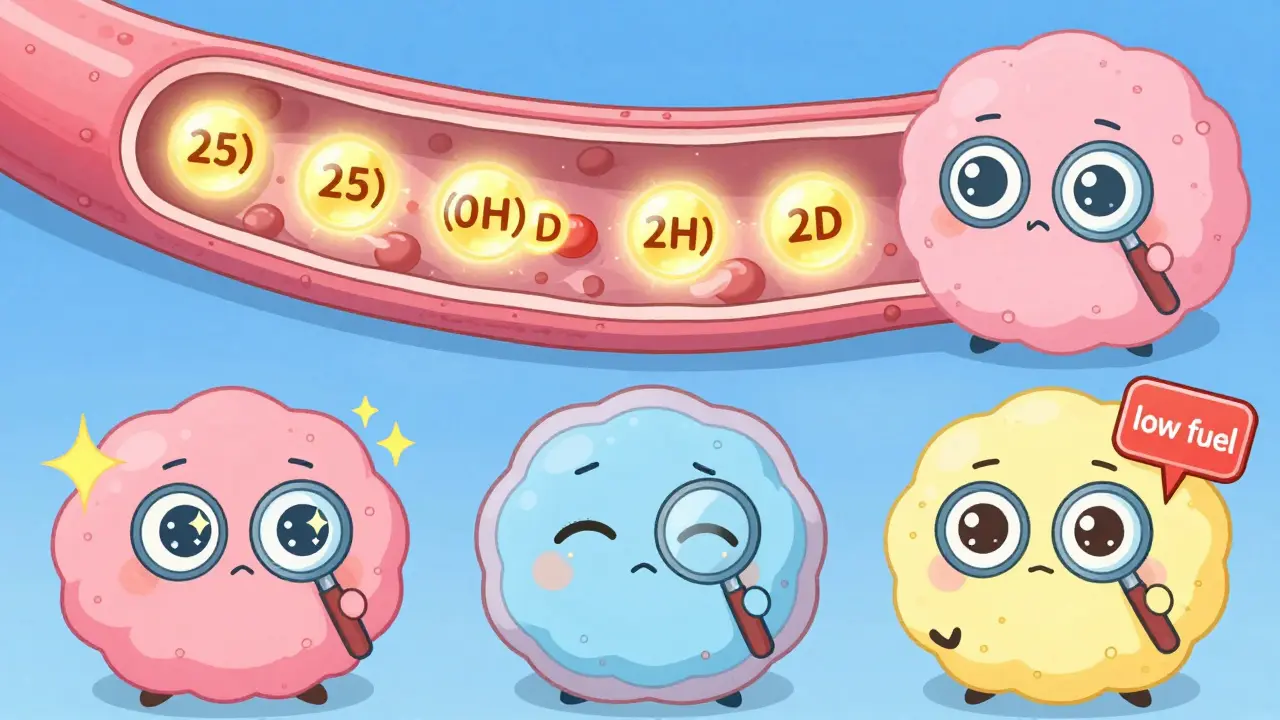
Here’s where most supplement advice falls short. Vitamin D doesn’t just work through your bloodstream. In many tissues - like immune cells, pancreatic beta cells, and even your skin - local cells can make their own calcitriol. They take the 25(OH)D in the blood, convert it right there, and use it on the spot. This is called autocrine or paracrine signaling. It’s independent of your kidneys. It doesn’t care what your blood test says.
That’s why two people with the same 25(OH)D level can have totally different outcomes. One might feel energized and have strong immunity. The other might still be fatigued and prone to infections. The difference? Their tissues may be converting and using vitamin D differently. A 2006 study in Science showed immune cells ramp up calcitriol production 100-fold during infection - even if their blood levels were normal. So, your blood test might say you’re fine, but your immune cells could be starving.
What Do the Numbers Really Mean?
The Endocrine Society says vitamin D deficiency is below 20 ng/mL, insufficiency is 21-29 ng/mL, and sufficiency is 30-100 ng/mL. The Institute of Medicine says 20 ng/mL is enough for 97.5% of people. So which is right? The answer: it depends on what you’re looking for.
If you care about bone health, 20 ng/mL is enough. But if you care about immune function, muscle strength, or insulin sensitivity, you might need more. Studies show muscle weakness improves when levels rise above 30 ng/mL. Blood pressure drops in people with hypertension when levels hit 35 ng/mL. And in type 2 diabetes, some patients see better insulin response above 40 ng/mL.
The problem? We don’t have a standard test for tissue-level vitamin D activity. We only measure what’s floating in the blood. And that’s like checking the fuel gauge in your car and assuming the engine is running well - even if the fuel lines are clogged.
Supplementation: How Much, and for Whom?
Most daily multivitamins have 600-800 IU. That’s enough to prevent rickets. But is it enough to support endocrine health? Probably not for many people.
The Endocrine Society recommends 600-2,000 IU per day for adults under 70, and 800-2,000 IU for those over 70. But here’s the nuance:
- If you’re obese (BMI ≥30), you need 2-3 times more. Fat traps vitamin D like a sponge. One study found normal-weight people needed 1,500 IU to hit 30 ng/mL - but obese people needed 3,000 IU.
- If you have celiac disease, Crohn’s, or other malabsorption issues, you may need 1,000-2,000 IU extra daily - or even weekly high-dose regimens (like 50,000 IU for 8 weeks) to catch up.
- If you’re dark-skinned, live far from the equator, or wear sunscreen daily, you’re likely deficient. Sunscreen with SPF 30 blocks over 95% of vitamin D production.
The VITAL trial, which followed over 25,000 people for five years, found 2,000 IU/day didn’t reduce heart attacks, strokes, or cancer. But it also didn’t hurt. And it did raise 25(OH)D levels by about 5-10 ng/mL. That’s a modest gain - enough to help bone health, maybe not enough to fix immune dysfunction.
Why Some People Don’t Feel Better - Even With High Doses
On Reddit, you’ll find stories of people taking 10,000 IU/day for months and seeing no change. Others say their fatigue vanished in two weeks. Why the difference?
It’s genetics. Some people have variations in the CYP2R1 gene - the one that turns vitamin D into 25(OH)D in the liver. If it’s slow, even high doses won’t raise blood levels much. Others have variations in the DBP gene, which makes the protein that carries vitamin D in the blood. If DBP binds too tightly, less vitamin D is free to enter cells. That’s why some experts now measure “free 25(OH)D” - the unbound, active portion - instead of total levels.
Also, vitamin D doesn’t work alone. It needs magnesium to activate. If you’re low in magnesium, your body can’t convert vitamin D properly. And calcium intake matters too. Too little, and vitamin D can’t do its job. Too much, and it can cause problems.

When Supplementation Can Be Dangerous
More isn’t always better. Vitamin D toxicity is rare, but it happens. The Endocrine Society says levels above 150 ng/mL are toxic. Symptoms include nausea, vomiting, weakness, frequent urination, and kidney stones. In extreme cases, calcium builds up in your blood vessels and heart.
People with sarcoidosis, lymphoma, or overactive parathyroid glands are at higher risk. Their bodies make calcitriol independently - so extra supplementation can push levels into danger.
And here’s the irony: many people take high doses because they read online that it boosts immunity or prevents cancer. But the science doesn’t back that up. A 2014 meta-analysis of 81 trials found no significant reduction in cancer or heart disease with supplementation. Animal studies look promising. Human trials? Not so much.
Who Should Get Tested?
Testing isn’t needed for everyone. The US Preventive Services Task Force says there’s not enough evidence to screen healthy adults. And yet, over 35 million vitamin D tests were done in the U.S. in 2023 - up 400% since 2008. Why? Patient demand.
Doctors report that 68% of vitamin D tests are requested by patients, not based on clinical need. And many of those tests are unnecessary. You don’t need a test if you’re healthy, eating well, and getting sunlight.
But testing makes sense for:
- People with osteoporosis or frequent fractures
- Those with chronic kidney disease
- Patients with celiac, Crohn’s, or bariatric surgery history
- People with unexplained muscle weakness or chronic fatigue
- Obese individuals (BMI ≥30)
For these groups, testing and targeted supplementation can be life-changing. One study showed that correcting vitamin D in kidney patients reduced parathyroid hormone levels by 40% and lowered hospitalization rates.
The Future: Beyond the Blood Test
Scientists are now looking past the 25(OH)D test. The NIH’s Vitamin D Exposome Project is developing ways to measure vitamin D activity directly in immune cells - using RNA sequencing to see which genes are turned on. That’s the future. Instead of guessing based on blood levels, we’ll know what’s happening in your tissues.
Pharmaceutical companies are also working on synthetic vitamin D analogs that target specific organs. One, called eldecalcitol, is already approved in Japan. It strengthens bone without causing high calcium. Another, VDRM-110, is being tested to help insulin production in type 2 diabetes - without the risk of hypercalcemia.
For now, the best advice is simple: get sunlight when you can. Eat vitamin D-rich foods (fatty fish, egg yolks, fortified dairy). If you’re at risk, take 1,000-2,000 IU daily. Re-test in 3 months. And don’t chase sky-high levels hoping for miracle benefits. Your bones will thank you - even if your immune system doesn’t.
Lorna Brown
March 15, 2026 AT 17:24It’s wild how we treat vitamin D like a simple supplement when it’s basically a master switch for hundreds of genes. I’ve been reading up on VDR polymorphisms lately, and it makes total sense why two people with the same blood level can feel totally different. One’s immune cells might be starved while the other’s are thriving. We’re measuring the wrong thing. We need tissue-level assays, not just serum 25(OH)D. The science is there - we just haven’t caught up yet.
Also, magnesium. Always magnesium. No one talks about how you can take 5,000 IU of D and still be functionally deficient if your Mg is low. It’s like buying a Ferrari and never filling the tank because you think the gas gauge is broken.
Rex Regum
March 17, 2026 AT 03:21Oh great, another vitamin D cultist. You people act like this is the cure-all for everything from depression to cancer. Newsflash: your body evolved without supplements. Sunlight. Food. Movement. That’s it. Now everyone’s popping 10k IU like it’s gummy vitamins and wondering why they’re jittery and have kidney stones. Stop overmedicalizing nature. You’re not a lab rat in a petri dish.
Kelsey Vonk
March 18, 2026 AT 15:19I love how this post breaks it all down 😊 I’ve been taking 2k IU daily since last winter and honestly? My fatigue is gone. Not magic, not miracle - just… better. Like my body finally stopped begging for help.
Also, I got my free 25(OH)D tested last month - turns out my bound levels were fine but free was low. My doc was shocked. Turns out I have that DBP variant. Who knew? 🤯
Emma Nicolls
March 19, 2026 AT 00:57so i took 5000iu for 6 months and nothing changed then i started taking mag citrate and boom energy back like i was 25 again 🤷♀️ why dont they teach this in med school??
also i live in seattle and its literally 8 months of gray here. i dont think i even saw the sun once last winter. but i still got my levels up without pills just by sitting by the window. weird huh?
Jimmy V
March 20, 2026 AT 08:11Stop. Just stop. If you’re obese, malabsorbing, or don’t get sun - supplement. No debate. 1000-2000 IU daily is a baseline, not a ceiling. The VITAL trial didn’t show cancer reduction? So what? It didn’t show harm either. You’re not trying to cure cancer. You’re trying to keep your parathyroid from eating your bones. That’s enough.
And yes - magnesium. Always. And calcium balance. And retesting. This isn’t witchcraft. It’s biochemistry. Do the work.
Richard Harris
March 21, 2026 AT 07:49Interesting read, though I wonder if the focus on blood levels distracts from the bigger picture. I’ve known folks in rural Scotland who never took a supplement, worked outdoors, ate oily fish, and still had decent levels. Maybe it’s not just about dosage - it’s about lifestyle, rhythm, connection to natural cycles. We’ve forgotten how to live in tune with the sun.
Also, typo: 'vitamin D isn't a vitamin in the traditional sense' - yes, but it's still called a vitamin. Irony.
Kandace Bennett
March 22, 2026 AT 18:02OMG I’m so glad someone finally said this 🙌 I’ve been telling my friends for YEARS that the 20 ng/mL standard is a joke for immune health. I’m in LA, dark skin, sunscreen daily - I was at 18 ng/mL and felt like a zombie. Hit 42 after 3 months of 4k IU + magnesium. My psoriasis cleared. My mood? Night and day.
And if you’re not testing free D, you’re basically guessing. Like trying to fix your car by only checking the dashboard light. 😘
Tim Schulz
March 23, 2026 AT 15:51Oh wow. Another ‘vitamin D fixes everything’ lecture. Let me guess - you also drink celery juice and sleep on a copper mat? 😏
Let’s be real: 80% of people who think they’re ‘deficient’ are just bored, anxious, and looking for a biochemical excuse to feel special. Your fatigue? Probably your job. Your immune issues? Probably your Netflix binge habits. Stop blaming your genes. Go outside. Eat an egg. Breathe.
And no, I don’t need a blood test to know I’m fine. I’m not a lab experiment.
Jinesh Jain
March 24, 2026 AT 15:00Very detailed post. I live in India, get sun daily, eat fish once a week, and take 1000 IU. My level is 34. My cousin takes 5000 IU and is still at 28. Genetics must be huge here. Also, we don't test here much - doctors say if you're not sick, don't bother. Makes sense. No need to overthink.
douglas martinez
March 26, 2026 AT 10:07It is imperative to recognize that vitamin D metabolism is a complex, multi-system process influenced by genetic, environmental, and nutritional variables. While supplementation may benefit specific populations, blanket recommendations without individualized assessment risk both under- and over-treatment. Clinical judgment, supported by targeted laboratory evaluation, remains the gold standard. The data presented herein underscores the necessity for precision medicine approaches in endocrine nutrition.
Sabrina Sanches
March 26, 2026 AT 20:59Just wanted to say… I had chronic fatigue for 3 years… then I found out I had low magnesium… and my D was borderline… took 400mg mag glycinate and 2k D… and boom… I’m not tired anymore… like… at all…
also… sun is free… and it’s beautiful… go sit outside… you’ll feel better…
thank you for this post… it helped me…